

by Fatima Winniclare Jayme, LPT, MBA, EdD

Conspiracy theory and stealth advocacy are distinct yet related concepts in public discourse, both involving hidden information and motives but differing in their origins, intent, and perception.
Stealth advocacy occurs when individuals, including scientists or experts, present their policy preferences as objective, scientific conclusions while avoiding openly declaring their value judgments or agendas. This can involve appealing to alleged conspiracies as a powerful way to advance political causes, making it a potentially insidious and effective strategy for manipulating public discourse.
Conspiracy theory and stealth advocacy are separate yet interconnected notions in public discourse, both encompassing concealed information and goals but differing in their origins, intentions, and perceptions. Stealth advocacy transpires when individuals, such as scientists or experts, articulate their policy preferences as impartial, scientific findings while refraining from explicitly disclosing their value judgments or agendas. Such behavior may entail invoking purported conspiracies as a potent means to promote political agendas, rendering it a potentially devious and successful tactic for influencing public debate.

Conspiracy theory and stealth advocacy are distinct yet related concepts in public discourse, both involving hidden information and motives but differing in their origins, intent, and perception. Stealth advocacy occurs when individuals, including scientists or experts, present their policy preferences as objective, scientific conclusions while avoiding openly declaring their value judgments or agendas. This approach can involve appealing to alleged conspiracies as a powerful way to advance political causes, making it a potentially insidious and effective strategy for manipulating public discourse.
THE RELATIONSHIP BETWEEN THE TWO
The primary connection is a shared reliance on hidden information or motives.
Conspiracy theories suggest a covert operation by external groups. It alleges a secret plot twist by external groups.
Stealth advocacy uses secrecy about its motives to advance a cause.
Both concepts highlight a breakdown in trust and transparency in communication. The difficulty in identifying real conspiracies and distinguishing them from theories, combined with the prevalence of deliberate disinformation and hidden agendas in public discourse, makes the general public more susceptible to both malign influences. Exposing the source of such campaigns doesn’t always lessen their force, indicating a deeper issue with public susceptibility and existing biases.

The term “stealth advocacy” refers to when an individual, such as a scientist or policymaker, presents their policy preferences as objective, value-free facts or scientific conclusions, rather than openly acknowledging the underlying values and assumptions. Both conspiracy theories and stealth advocacy involve a lack of openness and an attempt to control the story or public opinion by hiding true intentions or the nature of information.
THE INTERCONNECTION BETWEEN THE TWO

The fundamental link is a mutual dependence on concealed knowledge or intentions. Conspiracy theories propose a clandestine activity by other entities. The theory claims that other entities are involved in a clandestine conspiracy. Stealth advocacy employs concealment of its intentions to promote a cause.
Both themes emphasize a deterioration of trust and transparency in communication. The challenge of discerning genuine conspiracies from mere hypotheses, coupled with the widespread dissemination of intentional disinformation and concealed goals in public discourse, renders the general populace increasingly vulnerable to both nefarious influences. Revealing the origin of such ads often fails to diminish their impact, suggesting a more profound problem with public vulnerability and inherent prejudices.
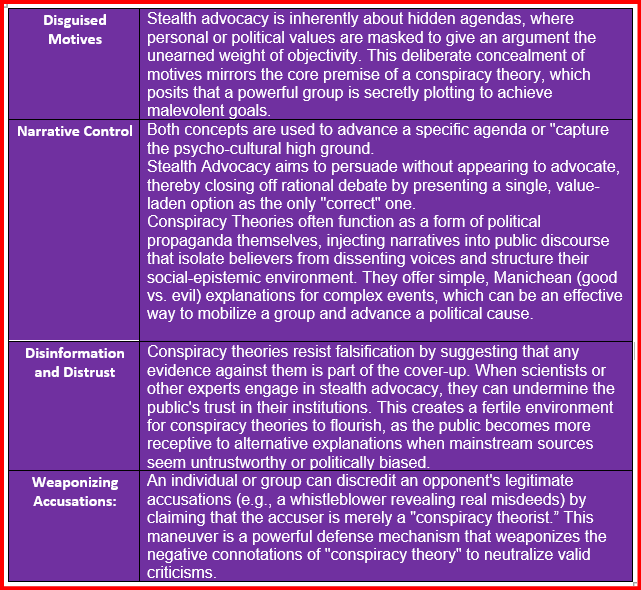
“Stealth advocacy” denotes the practice whereby an individual, such as a scientist or policymaker, articulates their policy preferences as impartial, value-neutral facts or scientific determinations, instead of transparently recognizing the foundational beliefs and assumptions involved. The connection between conspiracy theory and stealth advocacy lies in their shared characteristics of opacity and the manipulation of narrative or public perception through the concealment of genuine motives or the essence of information.
Until next time
Cleverpen Fatywines



 Cleverpens
Leave a comment