

by Fatima Winniclare Jayme, MBA. EdD.,LPT

In the domain where intervals extend infinitely, the nature of time is revealed, showcasing the complex interplay of existence that goes beyond the mere movement of clock hands. This exploration aims to comprehend the complex challenges that exist beyond our physical reality, where the essence of existence aligns with the universe. In the context of time, where moments progress continuously, there exists an ongoing journey, a structure composed of the elements of infinity. Each heartbeat signifies a continuous progression, a sequence of transformations that flows like the gentle breeze across the expansive landscape, perpetually advancing without retrospection. In an alternate realm, where time remains constant, exists a location where each heartbeat resonates, embraced by a perpetual present.
Eternity reveals itself as an unbounded expanse, a complex structure interlaced with countless potential outcomes. It summarizes a perpetual conflict, where instances extend indefinitely yet remain static, a conundrum that has engaged the intellects of scholars throughout history. While it may imply an infinite duration in informal conversation, it holds significant depth when analyzed as the core of existence, intricately linked with the divine or the ultimate truth that directs our understanding. Within the core of our existence, there are subtle indications of a reality, a commitment that we can rise above the relentless passage of time. By harnessing the principles of mindfulness and the clarity of focused thought, we can engage with the boundless, where the fundamental nature of time diminishes, revealing only the rhythm of being.
Time is a quantifiable, sequential flow of moments categorized as past, present, and future. In contrast, timelessness embodies characteristics, concepts, or entities that remain impervious to the passage of time—eternal, classic, or transcending chronological boundaries. This state is often articulated as a condition in which the present moment is wholly engaged or as the essential physical principles that govern the nature of time itself. Time represents change and sequence, whereas timelessness signifies permanence, beauty, or truth that transcends eras, existing in the present or within a more profound, atemporal reality.
The above poem is bout the darkest hour falls not in the transition of dusk to dawn, but in the deep night between them—when twilight’s faint glow has fully faded. The stars we gaze up at don’t bring this darkness; rather, it’s pierced by the tiny light reflected in each other’s eyes. What time is the darkest hour of the day? answer: Between 3 am and 4am
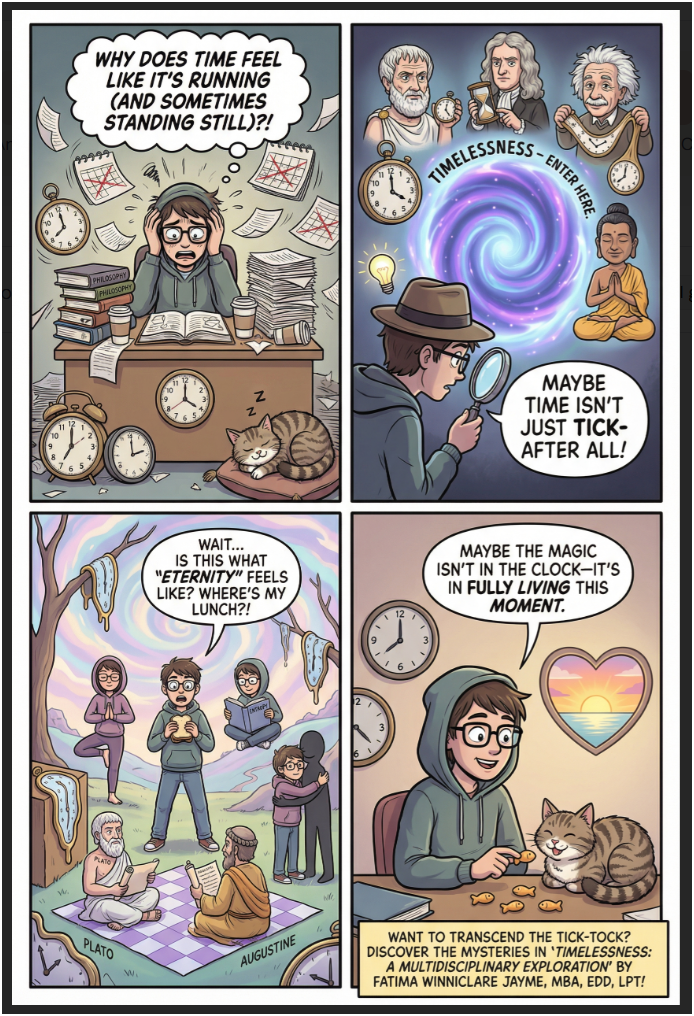
Conceptualizing Time
The concept of time, with its limitless nature and the complexities of existence that go beyond the confines of a clock, provides a framework for understanding what exists beyond our physical reality. The concept of infinite time refers to a continuous span without a beginning or end, characterized by an ongoing sequence of moments that progress like a shifting prairie wind, constantly evolving and advancing.
“Timelessness” refers to a state that transcends the passage of time, where every moment coexists at once, depicted as an “eternal present.” The idea of eternity represents a complex concept, characterized by its vastness, akin to wide landscapes. It presents a contradiction regarding time, where it appears to stretch endlessly while also seeming to stop, a puzzle that has intrigued philosophers throughout history. While it may imply an infinite duration in everyday conversation, it holds a deeper significance when exploring the fundamental aspects of existence in connection with the divine or ultimate reality. Some perspectives suggest that individuals can reach a state of timelessness through deep presence or meditative experiences, where the linear flow of time becomes unclear.
Time and Faith in Contemporary Culture
Time is conventionally understood in a linear fashion within contemporary culture, characterized by organized schedules and timelines. Christianity has preserved earlier societies’ perception of time as cyclical, aligning with the rhythms of nature. Figures like Augustine underscored this circularity, emphasizing humanity’s dependence on God. Flannery O’Connor demonstrates this cyclical nature through her characters, who frequently undergo disruption to acknowledge their reliance on divine grace, as exemplified in her stories like “Greenleaf,” where characters represent various relationships to time and existence. O’Connor’s narrative technique, which is frequently nonlinear, reflects the intrinsic disorientation of the gospel, challenging contemporary perceptions and prompting acknowledgment of our ultimate dependence on God. Her work reminds readers that genuine fulfillment arises from surrendering all to God and embracing the complex relationship between time and faith.
Jung’s Perspective of Time
The examination of time is a detailed and intricate subject that has captivated philosophers, scientists, and intellectuals across the ages. Time serves as a critical element in understanding human existence, impacting various fields and approaches. This examination does not aim to solve the mysteries of time but instead focuses on exploring Carl Gustav Jung’s perspectives on the subject, along with the historical evolution of our understanding of it.
All over, ancient civilizations perceived time as a fundamental aspect of their lives, shaped by natural cycles and mythological narratives. The Greeks distinguished between Chronos, which represents infinite time, and Kronos, the Titan associated with consumption and decay. This distinction highlights a prevalent misconception in contemporary discussions about time.
The majority of philosophers and scientists have examined time through different perspectives, with Archimedes and Newton supporting a definitive, linear understanding, whereas Einstein proposed the idea of time being relative, indicating that it depends on the observer’s frame of reference. The current discourse surrounding absolute versus relative time carries significant consequences for our comprehension of reality.
Psychoanalysis understands the concept of time from both fixed and contextual perspectives. Freud’s insights into the unconscious mind demonstrate that memories and experiences operate independently of time, highlighting a multifaceted connection between temporal dynamics and human awareness. Freud distinguished between two forms of time: one associated with memory and repetition, and another linked to conscious experience, highlighting the eternal quality of the unconscious.
The discussion surrounding time continues to be ambiguous, influencing our understanding of human experience and existence. The relationship between absolute and relative time remains a focal point in both philosophical and scientific discussions, highlighting the complex essence of temporality in human existence.
The Distinction of Time and Timelessness
Understanding the nature of time (memory, sequence) enables us to appreciate the timeless, which exists beyond our grasp.
In physics, some ideas about quantum gravity say that time might not be a basic part of the universe but rather something that comes from other things. The “block universe” theory says that all moments exist at the same time, which means that the universe is basically timeless.

Philosophical Perspectives on Time and Timelessness
In comprehensiveness and space, the collection encompasses a vast timeline, presenting a variety of viewpoints from key intellectuals regarding the essence of time and the realms that extend beyond it.
The “Great Conversation” aims to illustrate the ongoing debate and reinterpretation of timeless questions throughout the centuries, fostering a dialogue that transcends time. From the fundamental principles of metaphysical reality as posited by Plato to the exploration of human purpose by Aristotle and extending to the spiritual longing articulated by Augustine, these texts establish a foundational framework for comprehending our temporal existence. Engaging with these texts offers a thorough exploration of humanity’s efforts to understand the progression of time, the concept of eternity, and our role within these frameworks.
Deepak Chopra asserts that while the brain processes time in the present, human consciousness acts as a conduit that converts the timeless into temporal experience.
Jiddu Krishnamurti differentiates between chronological time (necessary for daily existence) and psychological time (memory). He says that “timelessness” is a state in which the mind is free from the weight of memory and the process of “becoming.”
Regarding design and architecture, timeless design is not tied to a specific time or style. In architecture, it refers to buildings that blend seamlessly with their surroundings, remaining visually appealing and functional for decades.
In content and media, “timely” content, like news, loses its value quickly, while “timeless” content, like writing advice, stays relevant regardless of when it is read.
Temporal Dynamics of Time
Scholars have examined the concept of time for centuries, presenting diverse perspectives.

The discussion surrounding Presentism and Eternalism highlights a significant philosophical inquiry into the nature of reality across various temporal moments.
Presentism asserts that only objects and events occurring in the present moment possess reality. Eternalism, often referred to as the “block universe” theory, posits that the past, present, and future coexist simultaneously and are all tangible within a four-dimensional framework of spacetime.
Time can be categorized into various types, including everyday civil time units such as seconds, minutes, and hours, along with variations like daylight saving. Additionally, there are scientific measures like Universal Time (UT), Julian Dates, and Sidereal Time. Philosophical concepts also play a role, contrasting Greek Chronos (sequential) with Kairos (opportune), as well as subjective psychological time, which pertains to the perception of time’s passage. Time is quantified using clocks, whether analog or digital, and calendars. It can also be considered relative, like relativistic time, or even as not existing at all in some theoretical frameworks.
Understanding Time
Time can be categorized into various types, including everyday civil time units such as seconds, minutes, and hours, along with variations like daylight saving. Additionally, there are scientific measures like Universal Time (UT), Julian Dates, and Sidereal Time. Philosophical concepts also play a role, contrasting Greek Chronos (sequential) with Kairos (opportune), as well as subjective psychological time, which pertains to the perception of time’s passage. Time is quantified using clocks, whether analog or digital, and calendars. In some theories, it can be seen as relative, like relativistic time, or nonexistent.

Einstein’s Theories on Time
Albert Einstein’s contributions to modern physics revolutionized the scientific understanding of time.
Time Dilation and Relativity: Einstein’s theories of relativity, encompassing both special and general, demonstrated that time is not a constant but fluctuates based on the observer’s motion and the gravitational context they experience. Atomic clocks and other precise instruments have shown that time dilation really happens.
The notion of spacetime can be perceived as a four-dimensional structure, where the essential connection between time and space facilitates the distortion effects caused by mass and energy.
The Arrow of Time and Entropy: Fundamental equations in physics often demonstrate time symmetry, operating the same way whether time moves backward or forward. The observable, one-way progression of time, commonly known as the “arrow of time,” is fundamentally explained by the Second Law of Thermodynamics: the universe evolves from states of lower entropy (order) to higher entropy (disorder).
The present discourse in physics focuses on the nature of time: is it a fundamental component of reality, or does it emerge from more profound quantum phenomena, such as quantum entanglement? Certain theories of quantum gravity propose a universe lacking time, positing that the notion of time arises from the interactions among diverse subsystems.
Conscious, Time, and Identity
Conscious experience predominantly focuses on the present, creating a perception of time as a continuous flow, in contrast to indistinct memories or future expectations.
Identity is influenced by temporal factors, which structure our experiences, recollections, and self-concept, connecting our past, present, and future identities
Eastern philosophies, exemplified by Advaita Vedanta, regard time as a component of maya (illusion), positioned within the ephemeral phenomenal world, which contrasts with a reality that is eternal and immutable.
The Link of Time to Existence
The exploration of time is fundamentally connected to the essence of existence. The awareness of time’s passage provides structure and meaning to our lives. Before birth and following death, when awareness is absent, the subjective experience of time is nullified; what remains is the continuous, objective flow of cosmic time.
Time serves as the essential structure for comprehending change and the relationships between cause and effect. This illustrates the sequential impact of one event on another. Without time, ideas like motion and the passage of life, such as growth and decay, lose their meaning.
Metaphysics represents a branch of philosophy that examines the fundamental nature of reality and existence. The concept of time serves as a fundamental framework for examining existence, identity, and the structural composition of the universe. This inquiry explores fundamental questions about the nature of existence.
The Arrow of Time and Human Experience
For people, time is mostly linear and goes in one direction. We are born, we become older, and we die. A broken egg does not put itself back together to form a whole egg. This situation is caused by the “arrow of time” that the Second Law of Thermodynamics (entropy) says happens: isolated systems go from order to disorder.
In human experience, time is regarded as fundamentally linear and a limited resource necessitating prudent utilization. Essential components include the significance of presence, which lies in maximizing the current moment and fully engaging with it, as time is irreplaceable.
Causality dictates that events occur in a specific sequence of cause and effect (e.g., one cannot consume an apple before its existence). Our brains are programmed to see this order of events, which helps us remember the past and become ready for the future.
Time is measured using clocks, and calendars are things that people made that measure time in linear, cumulative units (seconds, days, years).
Modern physics offers a complex perspective, indicating that the linearity of time is not as simple as our daily experiences imply
The spacetime continuum, according to Einstein’s theories of relativity, asserts that time is fundamentally connected to space within a four-dimensional structure referred to as spacetime.
Time dilation refers to the non-uniform progression of time across different locations. The speed of an object and the strength of the gravitational field can change how quickly time passes. Clocks demonstrate a reduced rate when subjected to stronger gravitational fields or in proximity to objects moving at high velocities. This concept represents a concrete aspect of the physical domain, necessitating consideration by technologies such as GPS. Time may be perceived as nonlinear, indicating a distortion in its progression.
The fundamental principles of physics demonstrate time symmetry, signifying that the equations hold irrespective of the direction of time’s progression or reversal. The observable “arrow of time” is widely recognized as an emergent phenomenon associated with the expansion of the universe and the increase of entropy, rather than a fundamental, universal direction of time.
Quantum Mechanics and Philosophy: Certain theoretical physicists and philosophers, such as Carlo Rovelli, propose that time may not be a fundamental component of reality but rather an illusion or a byproduct of the manner in which our consciousness interprets an information-driven reality. Although our subjective perception of time appears linear, the principles of physics reveal a more intricate objective reality, implying that time may be a flexible and relative dimension or not a fundamental aspect at all.
Inquiry into the Nature of Time
The investigation of time encompasses both philosophical and scientific aspects, revealing its complicated relationship with human awareness and experience. The examination of historical perspectives on time reveals its development as a crucial element of existence, spanning from ancient civilizations to contemporary theories. The distinction between absolute and relative time highlights the ongoing debate regarding its nature, with implications for how we understand causality, memory, and the human psyche.
Philosophers such as Heraclitus, Aristotle, and Kant have made significant contributions to the discussion on time, each providing distinct perspectives that highlight the intricacies of temporal perception. The shift from Newtonian absolute time to Einstein’s relative time represents a significant change in understanding, emphasizing the role of the observer in shaping the perception of time. Psychoanalytic theory, especially Freud’s contributions, adds complexity to this understanding by presenting the idea of timelessness in the unconscious, indicating that our psychological experiences operate outside of traditional temporal boundaries.
The discussion surrounding time is complex and varied. It incorporates elements from history, philosophy, and psychology. Such complexity encourages continuous investigation and contemplation, as time is a crucial factor in influencing human experience and comprehension.
The transient nature of time compels individuals to prioritize essential aspects, including relationships, kindness, and personal development.
Temporal experiences facilitate learning, reflection, and the capacity to progress from previous errors, despite the impossibility of altering them. The finiteness of human experiences and relationships highlights inherent value, despite the potential for associated pain.

Reflections on Time and Forever
The essence of time and forever encompasses reflections exploring the philosophical, spiritual, and personal dimensions of finite time and the idea of an existence beyond time. The idea emphasizes the significance of the current moment within the framework of lasting affection, heritage, and spiritual beliefs.
The idea of “forever” typically relates to concepts that transcend linear time or exceed physical existence, encompassing the enduring nature of love and memory, like affection for family, friends, and those who have passed away. Time is often described as a phenomenon that “never truly fades,” remaining present in our recollections. The fundamental impact of an individual persists in shaping and directing others, even after their departure. Different religious and philosophical perspectives characterize spiritual eternity as a perpetual existence or non-physical essence (soul) that persists beyond biological death.
The actions and contributions of individuals can generate a significant and enduring impact that extends beyond their lifetime, suggesting that their influence continues to resonate. The notion of eternity offers a sense of hope and certainty, suggesting a continuous love or bond that surpasses temporary circumstances.
Time and Eternity: A Metaphysical Exploration
The article “The Enduring Riddle: Navigating the Problem of Time and Eternity” examines the complex link between the notions of time and eternity, which are fundamental to metaphysical exploration. The discussion initiates with a clear definition that time is frequently viewed as a linear progression of occurrences, a metric for change, a facet of reality, and an individual experience. Eternity can be understood in two primary dimensions: first, as infinite duration, denoting time without a beginning or end, and secondly, as timelessness, signifying a state that transcends the limitations of time.
Philosophers have employed various perspectives to examine the nature of time. Aristotle conceptualized time as a metric for change, whereas St. Augustine highlighted its subjective characteristics, proposing that the past and future are constructs of the mind. Immanuel Kant proposed that time functions as an a priori form of intuition, influencing our perception of phenomena instead of existing as an independent entity.
The notion of eternity, particularly as articulated by Boethius, is characterized as a total possession of life within a timeless present. This stands in opposition to the concept of infinite duration, which nonetheless suggests a progression of events. The intersection of time and eternity raises significant philosophical questions, such as the function of eternity as a basis for time and the relationship between our subjective experiences and ultimate reality.
The article encourages readers to consider the implications of these concepts for comprehending existence, change, and consciousness. It posits that our experience of time shows a constrained viewpoint of a broader, timeless reality.

Newton’s Concept of Time and Its Impact
Isaac Newton’s “Principia Mathematica” presents the idea of absolute time as an uninterrupted progression, a notion that has significantly shaped both scientific inquiry and philosophical discourse, especially in shaping Immanuel Kant’s perspective on time as an inherent framework of perception. William James’s psychological perspective on the present moment as an extended interval illustrates a fluid experience of time, showcasing this continuity. Nevertheless, the analysis of biological and cognitive mechanisms challenges this assumption of uninterrupted time.
The examination of sensory data uncovers notable differences in timing, especially when comparing auditory and visual channels. Auditory stimuli are interpreted in under a millisecond, whereas visual cues require over twenty milliseconds for processing. This indicates that they reach the brain at varying intervals. Moreover, the duration required for visual adaptation is influenced by the intensity of the stimulus, complicating the integration of sensory inputs. The speed of sound is less than that of light, which means that the distance of the observer plays a crucial role in the timing of events. This establishes a “horizon of simultaneity,” wherein auditory stimuli may arrive at the observer before visual cues, contingent upon their respective distances.
To address these issues, the brain possesses mechanisms that enable it to assemble information dispersed across different temporal and spatial contexts, without the necessity of continuous time reliance. The mechanisms involved might include neural oscillations that generate “atemporal” system states, where traditional temporal relationships of stimuli do not apply. This indicates that cognitive processing might function through distinct shifts between these timeless states, questioning the conventional Newtonian view of time concerning brain and cognitive activities.
Key Themes & Authors in the Great Books
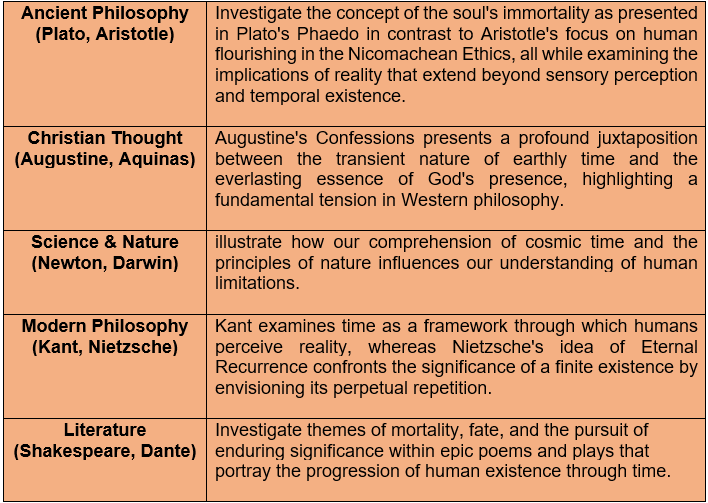
Eternity and Timelessness Concepts
Endless stretches of time, the vastness of the eternal, and the mysteries of existence beyond the ticking clock all paint a picture of what lies beyond our mortal coil. Endless time speaks of a stretch that knows no start nor finish, marked by an unbroken chain of moments rolling on like the prairie wind, ever changing and moving ahead. In stark contrast, timelessness speaks of a realm beyond the ticking of the clock, where all moments ride side by side, painted as an “eternal now.” In the dusty trails of thought, eternity stands tall, a notion as vast as the open plains, where time stretches endlessly and yet seems to stand still, a paradox that has puzzled many a thinker through the ages. It suggests a never-ending stretch of time in casual talk, but it holds a richer meaning when it comes to grasping the essence of life in the domain of the divine or the ultimate truth. Some reckon that folks tap into the eternal by way of deep presence or meditative journeys, where the straight line of time fades away like a ghost in the wind.
The terms “boundless time,” “timelessness,” and “eternity” allude to different philosophical and theological ideas of existence beyond human temporal experience.
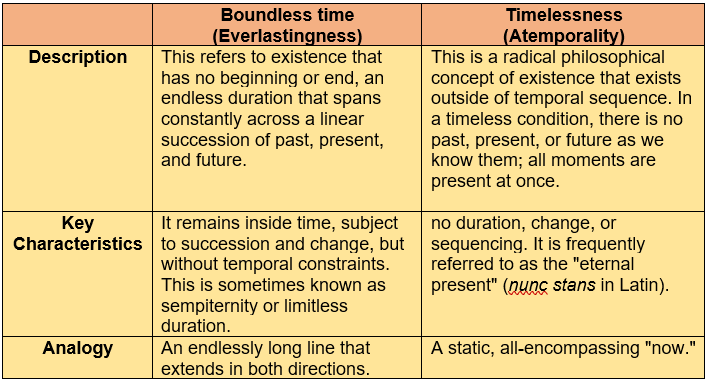
In ancient philosophy and religion, the term “eternity” refers to the timeless concept of existence, but it is commonly used colloquially to allude to limitless duration. The main interpretations of Boethius define timelessness as “the whole, perfect, and simultaneous possession of interminable life.” This is related to divine existence or ultimate reality (e.g., the Platonic Forms and the Hindu idea of Brahman). In less stringent usage, “everlastingness” might simply refer to existing for an endless amount of time.
In human experience, some philosophical and spiritual beliefs argue that people might see timelessness in moments of deep presence, meditation, or “flow” experiences, where linear time disappears into unchanging present consciousness
Critique of Time as an Empirical Concept
Time is not an empirical concept. Our ability to perceive coexistence or succession is contingent upon the existence of time as an a priori foundation for representation. Without this presupposition, we would be unable to conceive of things existing either simultaneously or at different times, meaning either contemporaneously or in succession.
Time serves as an essential representation, forming the basis of all our intuitions. We must understand phenomena in relation to time, yet we can conceive of time independently of phenomena. Time is thus provided a priori. The existence of phenomena is contingent upon the dimension of time. All of these may be negated in thought; however, time itself, as the universal condition for their possibility, cannot be negated.
The necessity a priori underpins the possibility of apodeictic principles regarding the relations of time, or axioms of time in general, such as “Time has only one dimension” and “Different times are not coexistent but successive” (in contrast to different spaces, which are not successive but coexistent). Experience cannot provide these principles because it lacks strict universality and apodeictic certainty. We should only state, “So common experience teaches us,” rather than asserting, “It must be so.” They serve as valid rules that make experience generally possible, guiding us about experience rather than through it.

REFERENCES:
Amaro, A. (2020). Time and timelessness. Mindfulness, 12(5), 1298–1300.. https://doi.org/10.1007/s12671-020-01531-2
Buccheri, R., Saniga, M., & Stuckey, W. M. (2012). The nature of Time: geometry, physics, and perception. Springer Science & Business Media.
Cunningham, D. S. (1994, December/January). The transfiguration of time. Sojourners, 23(1), 12–18. Retrieved from https://sojo.net/magazine/december-1994-january-1995/transfiguration-time
Espenak, F. (n.d.). EclipseWise – Glossary of Eclipse and Astronomy Terms. Retrieved from https://eclipsewise.com/help/glossary.html
God and Time | Internet Encyclopedia of Philosophy. (n.d.).
Kuypers, S., & Rijavec, S. (2025). Measuring time in a timeless universe. Physical
Review. D/Physical Review. D., 112(6). https://doi.org/10.1103/qfns-48vq
Nature of Time | Research Starters | EBSCO Research. (n.d.). EBSCO. Retrieved from https://www.ebsco.com/research-starters/physics/nature-time
Pollack, I. (1975). Identification of temporal coherence between auditory and visual channels. Perception & Psychophysics, 17(3), 277–284. https://doi.org/10.3758/bf03203212
Rieker, J., & Doran, M. (2025). Making time count: Kairos as temporal, methodological, and ethical innovation in qualitative applied linguistics research. Research Methods in Applied Linguistics, 4(2), 100207.https://doi.org/10.1016/j.rmal.2025.100207
Saulson, P. (2021). THE NATURE OF TIME AS A PUZZLE FOR NATURALISM.Zygon®, 56(4). https://doi.org/10.1111/zygo.12738
Soliman, R. (2025, December 22). Relativity Time dilation explained: the physics of time and why it moves differently in space. Science Times.
Sus, V. (n.d.). The Philosophy of Time: Study the nature of past, present, and future.The Collector. Retrieved from https://www.thecollector.com/philosophy-of-time/
The foundation of our intuitions. (n.d.). Lapham’s Quarterly. Retrieved from https://www.laphamsquarterly.org/time/foundation-our-intuitions
The Time Traveler’s Journal. (n.d.). Futurism. Retrieved from https://vocal.media/futurism/the-time-traveler-s-journal
Wang, A. Y. (2025). Applying Jungian psychology in reconstructing the understanding of time. Journal of Analytical Psychology, 70(3), 441–461. https://doi.org/10.1111/1468-5922.13093
Wikipedia contributors. (2025, November 23). Eternity. Wikipedia.


 Cleverpens
Leave a comment