
By: Fatima Winniclare Jayme
Educational systems serve as vital frameworks that necessitate compulsory schooling, typically spanning from early childhood through completing secondary education. There are notable distinctions, particularly regarding the Philippine K-12 system and the international ISCED (International Standard Classification of Education) standards.
The systems are composed of interconnected subsystems, encompassing management systems and, when applicable, advanced digital learning management systems (LMS).
Governments make a clear distinction between public and private schools within their educational frameworks, which indeed cover the spectrum from early childhood education to higher education. Essential features include compulsory education for children aged 5 to 15 or 16, the implementation of effective school management systems to enhance administrative efficiency, and notable global differences in educational structure. This observation becomes particularly evident when comparing the U.S. system with those of other countries. The K–12 system in the Philippines and the 13-year educational system in the U.S. exemplify these differences quite distinctly. Nonetheless, Singapore and Shanghai consistently excel in international educational rankings, underscoring the remarkable quality of their educational systems.
Asian school systems exhibit a distinct environment, marked by significant academic demands and an emphasis on standardized assessments. It is noteworthy to understand which among the strategies are considered effective. Key areas include the following:
East Asia is recognized for its rigorous national exams and focus on comprehensive development.
Southeast Asia, characterized by a mix of local and international curricula, and South Asia, noted for its centralized testing and vocational training methods.
European systems focus on equity and ensuring that all individuals have the opportunity to participate.
Nordic countries focus on student well-being and a positive educational atmosphere, whereas Western Europe incorporates vocational training alongside national curricula.
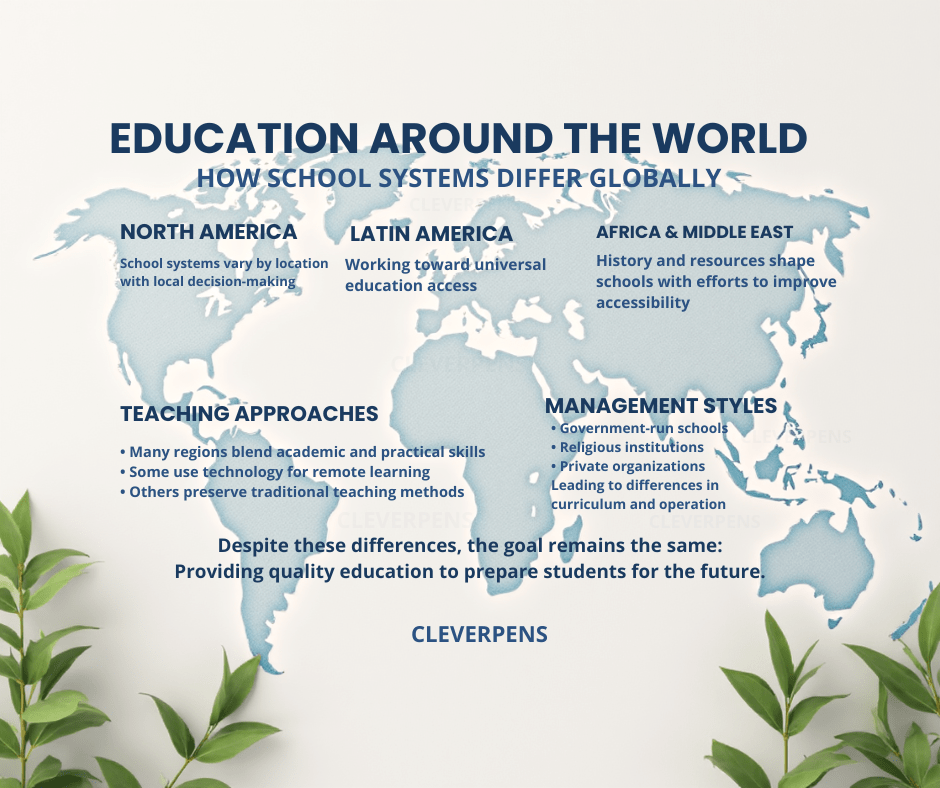
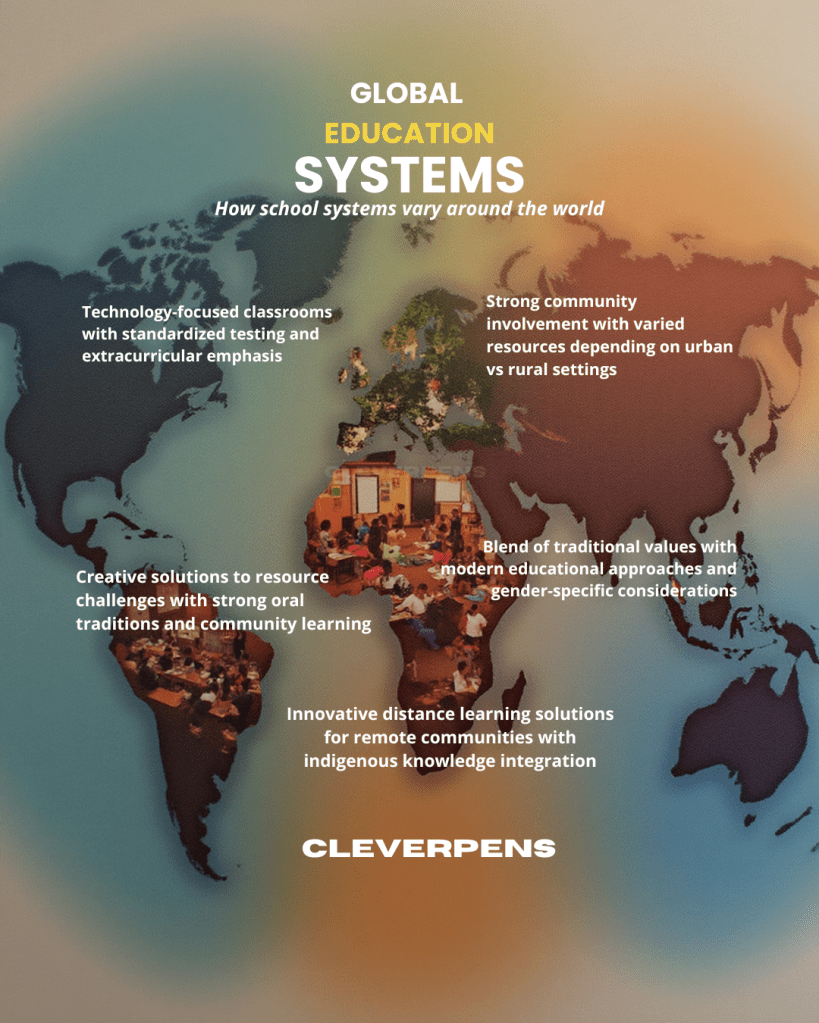
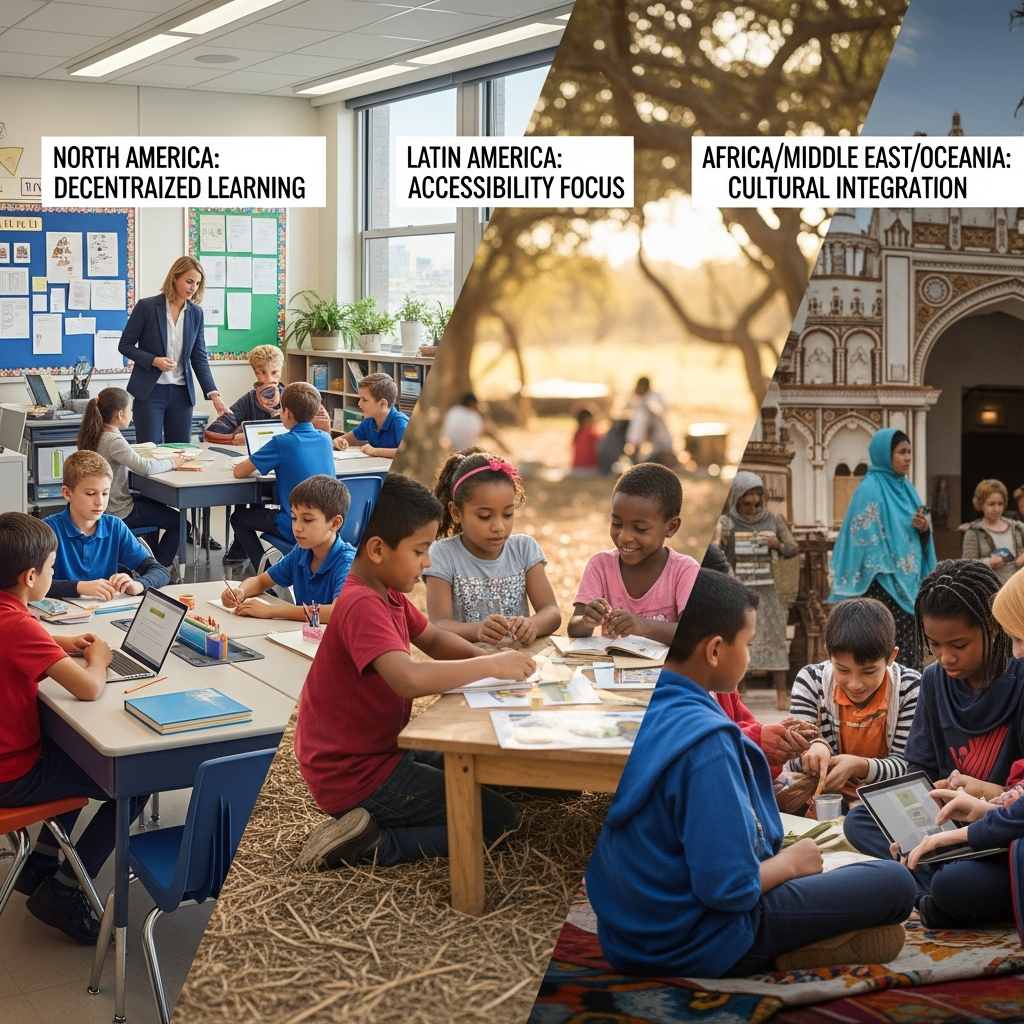
School systems in the U.S. vary significantly by region, featuring a decentralized approach in North America, while Central and South America are striving to enhance accessibility in education for all individuals. Historical contexts and available resources influence the education systems in Africa, the Middle East, and Oceania. They emphasize accessibility and the blending of cultures.
School Systems Up Close and Personal
There are four groupings worldwide, namely Asian, European, American, and the Rest of the World. Each exhibit features various models influenced by cultural, economic, and historical factors.
| School System Groupings | Description and Scope | Common Themes |
| Asian School Systems | It is recognized for its academic rigor and emphasis on standardized assessments. Important areas in East Asia include countries such as China, South Korea, Japan, and Singapore, which utilize high-stakes exams for student advancement and integrate a focus on math and science, along with comprehensive reforms inspired by Finland. Southeast Asia: Countries like the Philippines, Thailand, and Indonesia are enhancing access to basic education, integrating local and international curricula, and investing in vocational training. South Asia: India, Pakistan, and Bangladesh encounter challenges in ensuring fairness in centralized examinations while emphasizing the importance of vocational education to align with labor market demands. | A significant focus on community education, swift integration of technology, and the harmonious coexistence of tradition and modernization |
| European School Systems | Defined by a dedication to fairness and universal access while also reflecting regional differences. – Important Areas: The Nordic countries, including Finland, Sweden, and Norway, focus on the health and well-being of students by employing qualified teachers and minimizing testing requirements. Western Europe: Germany employs a dual education system, France adopts a centralized approach, and the UK provides multiple post-16 pathways through GCSE/A-Level examinations. Eastern Europe: Countries such as Poland and Hungary integrate aspects of their historical systems with EU standards and demonstrate strong performance in evaluations. | Inclusive education, strong vocational training systems, and an increasing emphasis on multilingualism |
| American School Systems | Encompassing North, Central, and South America, these systems exhibit significant diversity in governance and funding. Important Areas: North America: The US showcases various academic pathways with decentralized control, while Canada prioritizes equity and maintains high standards. Central America: Countries like Mexico and Costa Rica are enhancing quality and access, with Costa Rica recognized for its literacy achievements. South America: Brazil is working on reforms in its extensive public systems to address inequality, while Chile features a mixed school model that highlights the importance of educational choice. | Decentralization and inclusivity are important, along with initiatives that aim to address socioeconomic disparities. |
| The Rest of the World | Encompassing Africa, the Middle East, and Oceania, the influence of colonial histories and resource-related challenges contributes greatly to the development of these systems. Important Areas: Africa: Nations like Nigeria and South Africa are focusing on improving access to basic education and addressing inequalities from the apartheid era. Middle East: The UAE and Saudi Arabia are evolving their systems, while Israel emphasizes a robust STEM educational approach. Oceania: Australia and New Zealand adopt Anglo-American models, whereas the Pacific Islands emphasize the importance of cultural relevance in education. | Common themes focus on tackling resource constraints, promoting cultural integration, and strengthening resilience to conflicts and climate challenges. |
School systems in the U.S. are very different depending on where you are. In North America, each area makes its own choices about schools. Efforts are underway in Central and South America to ensure universal access to education.
In Africa, the Middle East, and Oceania, what happened in the past and what resources are available affect the schools. These places try to make schools easy to get to and mix different cultures. They also teach people to respect different traditions. Many places focus on teaching useful skills, like farming or building, along with reading and math. Such instruction helps students find jobs later on.
Some countries use new technology to help students learn, even if they live far away. Other places focus on keeping old traditions alive in their schools. Each area has its own way of teaching students what they need to know for the future. Some schools are run by the government, while others are run by religious groups or private companies. Such variation also changes how schools work and what they teach.
Key Takeaways:
Educational systems worldwide are critical frameworks enforcing compulsory schooling, spanning early childhood through secondary education. There are differences between systems like the Philippine K-12 and the international ISCED standards. These educational frameworks encompass both public and private schools and generally mandate education for children aged 5 to 15 or 16.
The systems in East Asia exemplify the opportunities that emerge from a collective commitment to academic excellence. Vocational models in Continental Europe successfully connect education with workforce needs, while Anglo-American systems focus on fostering individual talents and offering various options. The regional strategies seen in Southeast Asia, especially in the Philippines, highlight the development of systems that thoughtfully integrate tradition, accessibility, and global standards.
In terms of growth opportunities, cross-border learning offers significant potential.
Global variations are evident, particularly when contrasting the U.S. K–12 system with others, especially in Asia, where nations like Singapore and Shanghai achieve high educational rankings. Asian systems prioritize academic rigor and standardized assessments, whereas European systems advocate equity and student well-being. American systems showcase diversity in governance, with decentralized approaches in North America and varied reforms in Central and South America. Additionally, the Rest of the World grouping highlights how historical contexts, especially in Africa, the Middle East, and Oceania, shape educational access and quality, emphasizing that students require cultural relevance and resilience against challenges.
REFERENCES:
Chen, T. (2023). A Comparative Study of School District Systems in China and the United States: An analysis based on school choice in the elementary education stage. Lecture Notes in Education Psychology and Public Media, 24(1), 276–282. https://doi.org/10.54254/2753-7048/24/20230756
Education, I. T. F. O. T. F., & UNESCO. (2024). Global report on teachers: Addressing teacher shortages and transforming the profession. UNESCO Publishing.
OECD. (2025). Education at a Glance 2025. In Education at a Glance. OECD Indicators/Education at a Glance. https://doi.org/10.1787/1c0d9c79-en
Sullivan, O. (2025, November 20). What the World’s Best Education Systems Have to Teach Us. Teaching Times. Retrieved March 2, 2026, from https://www.teachingtimes.com/
Teacher Training and Student Learning—Past Values, Present Uncertainties, and Future Prospects: Past Values, Present Uncertainties, and Future Prospects. (2025). BOD – Books on Demand.
Team, G. E. M. R., & UNESCO (2021). Global Education Monitoring Report: Non-state Actors in Education. UNESCO Publishing.
UNESCO. (2022). Transforming Technical and Vocational Education and Training for successful and just transitions: UNESCO strategy 2022-2029. UNESCO Publishing.
Vicente, R. S., Reomero, J. I., Flores, L. C., Amora, M. S., & Almagro, R. E. (2024). Comparative Analysis of Two Educational Systems in Both Basic and Higher Education Between Japan and Singapore. Asian Journal of Education and Social Studies, 50(1), 114–135. https://doi.org/10.9734/ajess/2024/v50i11243
Wadia, L. C. (2021). Higher Education Systems and Policy in South Asia. In Global Education Systems (pp. 735–746). https://doi.org/10.1007/978-981-15-0032-9_50
Xiong, Z. (2024). Global Comparison of Education Systems. In Education in China and the World (pp. 331–388). https://doi.org/10.1007/978-981-99-5861-0_8



 Cleverpens
Leave a comment