
Here’s what you’ll learn when you read this story
- A severe typhoon left San Isidro homeless; residents shared messages of positivity on social media, focusing on resilience.
- Despite the uplifting messages, important issues like delayed relief supplies and unaccounted emergency funding persisted.
- Whyne’s questions about accountability faced resistance, as many preferred maintaining a positive narrative over addressing real concerns.
- The community learned that forced positivity can mask accountability, leading to apathy instead of constructive action.
- Both compassion and responsibility are essential; merely being thankful without questioning underlying issues can hinder progress.
Typhoon Relief and Community Support Messages
A severe typhoon struck San Isidro, leaving hundreds of households homeless. The town’s social media pages soon filled up with messages of support. “Stay strong!” read one post. “Pray and keep smiling!” urged another. However, many people often overlook the hidden dangers of forced positivity during community struggles in times like these.
“Many residents shared these messages. Thousands of hearts and words of encouragement poured in. People were complimenting each other on promoting positivism.
Evacuation Facility Aid Discrepancy
One of them was popular content creator Carlo. He shared daily inspiring messages about resilience. His supporters loved his positivity.
A week later, Whyne noticed something odd.
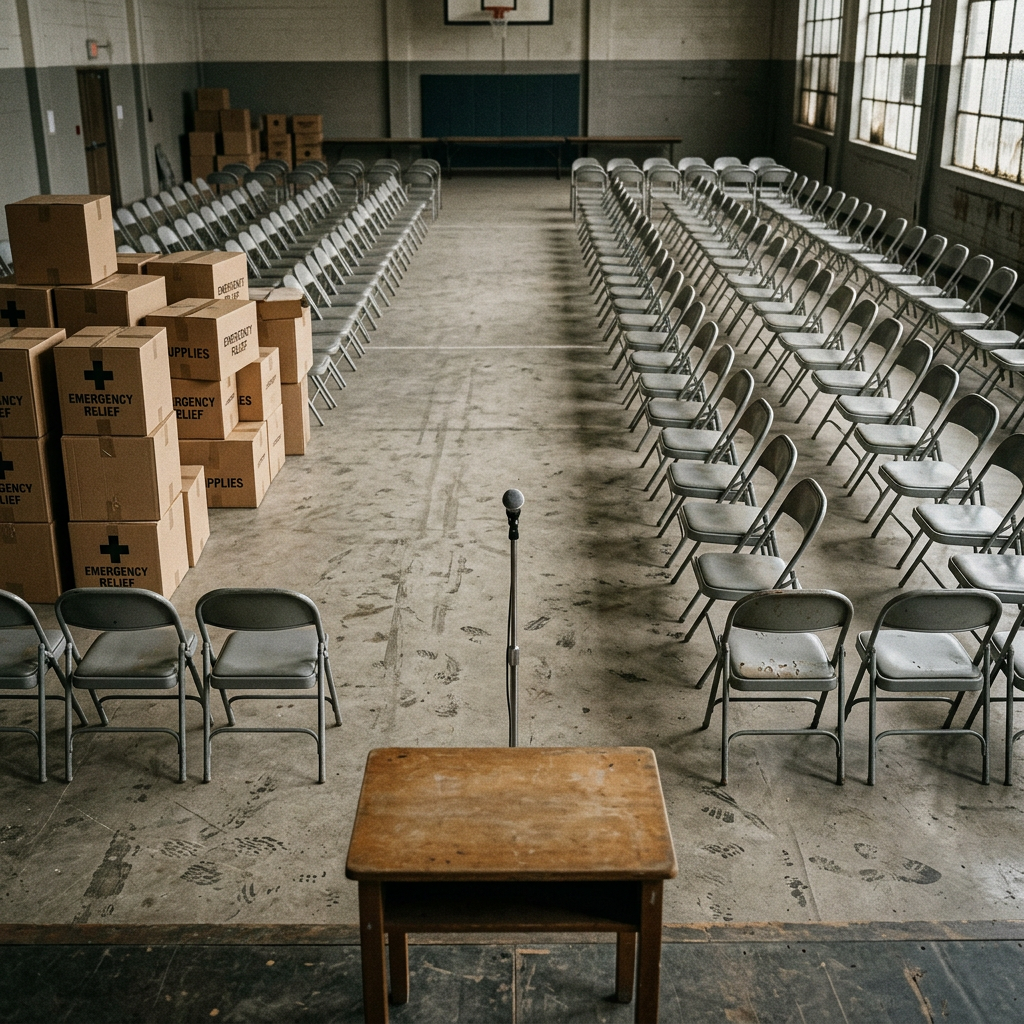
The evacuation facility still didn’t have medicine. There were some families who had not been assisted. Some personnel hadn’t been paid for emergency services. But the internet debates were almost exclusively about attitude and personal resilience.
“Why is the relief aid late?” Whyne asked during a neighborhood gathering.
The room went silent.
“People should just be thankful for what they have,” someone said.
Another added, “Complaining doesn’t help.”
Carlo nodded. “We need positive, not negative.”
Whyne paused. “Nobody’s attacking gratitude,” she continued. I am questioning why the supplies are not on time.”
But the subject soon moved back to pep talks.
Emergency Funding Diversion and Procurement Failures
Months later, the same problems were still there.
The journalist’s inquiry exposed the diversion of emergency funding. Procurement processes had broken down. Some officials ignored early warnings before the cyclone made its landfall.
Residents were startled.
They had been celebrating compassion, happiness, and thankfulness for months now. But those characteristics had quietly become shields against hard inquiries.
Subliminal Prejudice from Compelling Narratives
Carlo gradually realized that his messages had promoted a subliminal prejudice. People found solace in compelling stories; thus, they paid attention to them and dismissed information that contradicted them. The false belief that criticism and gratitude can’t coexist, as if criticizing judgments is ungrateful, reinforced the prejudice.
The town was taught a valuable lesson.
Gratitude is a virtue.
But thankfulness, exercised on the surface, might allow apathy.
A thriving community needs both kindness and responsibility since not all problems can be handled with encouragement alone. First, they have to be comprehended.
STORY RECAP
San Isidro Storm Aftermath: Relief and Accountability Issues
A storm ravaged San Isidro, causing many people to leave the area. A flood of encouraging support on social media focused on optimism and perseverance. But among the residents’ demonstrations of solidarity, questions remained about insufficient relief supplies and the lack of reimbursement for emergency workers. At a community forum, Whyne spoke about the delays in help but was met with opposition from people who wanted a brighter narrative rather than an accountable one. Months later, these problems remained, pointing to a breakdown in the mechanisms around emergency finance and procurement. The town learned that while appreciation is admirable, a superficial display of thanks can breed apathy. Compassion and responsibility are both necessary for a successful community, for support alone will not solve problems; they must be named and then handled as problems.

LESSON 1: VIRTUES AND VALUE REVIEW
Compassion and Accountability
| The Tension: The community begins to treat compassion as sufficient. As a result, compassion receives attention. Accountability receives resistance. The story asks: Can a community care about victims while also investigating why they needed help in the first place? This is the central tension. |
| Compassion | The townspeople want to comfort the victims. | They post: “Stay strong.” “Keep smiling.” “We’re praying for you.” |
| Accountability | Whyne asks: “Why are relief supplies delayed?” | She seeks explanations, responsibility, and corrective action. |
Social: Seeking harmony and truth-seeking
- The story asks: Should preserving harmony be more important than uncovering uncomfortable truths?
| Social Harmony | Truth-Seeking | The Tension |
| People want | Truth often requires | Whyne’s questions create discomfort. |
| Unity Peace Cooperation Avoidance of conflict | Difficult questions Disagreement Investigation Scrutiny | The community prefers reassurance. |
Individual Virtue and Institutional Responsibility
The story asks: Are social problems primarily a matter of character or of systems?
| Individual Virtue | Institutional Responsibility | The Tension |
| The dominant narrative promotes the following: | The journalist discovers the following: | The conversation focuses on how people should respond. |
| Gratitude Resilience Positivity Personal strength | Poor management Failed procedures Ignored warnings | Instead of: How institutions should perform. |
Emotional Comfort and Civic Responsibility
The story asks: Should society prioritize feeling better or understanding better?
| Emotional Comfort | Civic Responsibility | The Tension |
| Positive messages reduce fear and anxiety. | Responsible citizenship sometimes requires the following: | One path feels better. |
| People feel: Encouraged Supported Connected | Paying attention Asking questions Demanding transparency | The other path may be more necessary. |
Visibility and Significance
| Visibility | Significance | The Tension |
| The most visible content is | The most significant issue is the following: | The community notices what is visible rather than what is consequential. |
| Inspirational posts Viral messages Shareable comments | Why did the failures happen, yet that discussion receives less attention? | The story asks: Are we paying attention to what matters most, or merely to what is easiest to see? |
Synthesis
The supportive comments create a social script.
When someone says, “Stay strong.”
Others respond positively.
When someone asks, “Why are supplies delayed?”
The conversation becomes uncomfortable. Over time, the community learns. The result is not an explicit rule. It is a social norm.
| Acceptable | Less Acceptable |
| Encouragement Gratitude Optimism Resilience | Investigation Accountability Critique Institutional analysis |
LESSON 2: CULTURAL SENSITIVITY, LANGUAGE, AND SOCIAL NORMS
Cultural Sensitivity: Gratitude May Have Different Meanings
Cultural sensitivity, language, and social norms are important in this scenario because they influence how individuals perceive suffering, blame, criticism, and accountability. What seems like disinterest may stem from societal expectations about public speech and behavior.
In many communities, especially those that have experienced repeated hardship, gratitude and resilience are not merely virtues; they are survival mechanisms.
When residents say, “Be grateful.”
They may not be trying to dismiss problems.
They may genuinely believe gratitude helps people endure difficult circumstances.
A culturally insensitive observer might conclude, “These people don’t care about accountability.”
A culturally sensitive observer might ask, “What historical experiences made gratitude such an important value here?”
This distinction matters.
Language Shapes What People Notice
The words used in public discussions influence how people understand reality. Consider the difference:
| Language Used | Focus |
| “Victims must be resilient.” | Individual behavior |
| “Why was aid delayed?” | Institutional processes |
| “People should stop complaining.” | Emotional reaction |
| “People are raising legitimate concerns.” | Public accountability |
Social Norms About Respect and Authority
| Many cultures value | Respect for elders Respect for leaders Social harmony Avoidance of public confrontation |
These norms can be beneficial.
However, they can also create hesitation when institutions need scrutiny.
For example:
Whyne asks:
“Why are supplies delayed?”
Some residents may perceive it as
“She is questioning authority.”
Rather than
“She is seeking information.”
The meaning changes because social norms influence interpretation.
Norm Against Being “Negative”
Many communities have informal rules against appearing pessimistic.
| Criticism may be interpreted as: | Rather than civic participation. |
| Disrespect Disloyalty Lack of gratitude | Such behavior creates a social dilemma. |
People may remain silent not because they disagree with accountability but because they fear violating community expectations.
The Risk of Cultural Overcorrection
There is also a danger on the opposite side.
An analyst might conclude:
“Gratitude and resilience are obstacles to justice.”
Such feelings can become another bias.
Gratitude, optimism, and social harmony are not inherently problematic.
Many communities recover from crises precisely because of these values.
The challenge is balancing them with accountability.
Memes as Cultural Language
In Whyne’s story and in the typhoon story, memes become a social language
| Memes can: | A systemic problem requiring investigation becomes: |
| Build solidarity. Reduce stress. Help people cope. | A joke A punchline A relatable image |
| Yet they can also simplify complex issues. | The culture begins talking about the symptom rather than the cause. |
The Central Tension
The deepest tension in the story is between values that are neither good nor bad. It is between two legitimate social goods—between values that are neither good nor bad.
| Social Cohesion | Democratic Accountability |
| Encouragement Gratitude Respect Unity Harmony | Questioning Investigation Transparency Criticism Reform |
Reflection Question
A useful question for students, journalists, managers, and citizens is
When people say “be positive,” are they helping others endure hardship, or are they unintentionally discouraging discussion of the causes of that hardship?
The answer is often both or neither. It depends on the cultural context, the language being used, and whether social norms leave room for both compassion and accountability to coexist.
DISCLAIMER
The story in this work is purely fiction. Names, characters, places, and incidents are products of the author’s imagination or are used fictitiously. Any resemblance to actual events, locales, or individuals, living or dead, is entirely coincidental.
RELATED READINGS
© 2026 CLEVERPENS. All rights reserved.




Leave a Reply