

In this story, you’ll learn the following:
- The article uses a narrative to show how standards of accountability differ in the governance of organizations.
- Bruno the ox learns that while the paperwork is tight, accountability is usually a luxury for the strong.
- Does it question whether instructions should be viewed the same way at all levels of the organization?
- Work system theory and contingency theory emphasize adaptability and interconnectedness in modern work systems.
- The story is a meditation on the moral ambiguities of leadership and communication in the workplace.

This article is a hybrid read. It cannot confirm or speculate on the outcome of any investigation, legal proceeding, or administrative review apart from those in the public domain. Know the ethics, facts, and theories. What is interesting is the reality vs. interpretation, research ownership, and reader engagement. The results of studies vary. We should consider the lessons, personal benefits, and moral and hypothetical dilemmas.
Table of Contents
The Kingdom of Well-Formatted Papers
In the Kingdom of Well-Formatted Papers, every official announcement had to conform to the Royal Memorandum Template. No paper could be circulated without a reference number, date, subject, addressee, and signature of a competent official.
The King was particularly proud of this system. “Order is the foundation of good governance!” he proclaimed.
The royal scribes nodded. They had memorized the format.
The Ox Receives a Memorandum
One morning, an ox named Bruno was assigned to carry timber from the eastern forest to the royal construction site. Bruno received his instructions through a telephone call from the chief steward. “Deliver the timber before noon,” the steward ordered.
Bruno asked for written instructions. “Why make things complicated? We are all working for the kingdom!” replied the steward.
Bruno followed the instructions, but the timber arrived late because the bridge had been closed for repairs. By afternoon, Bruno received a memorandum.
Subject: Failure to Comply with Assigned Responsibilities
The document explained that Bruno had failed to meet the prescribed deadline. He was instructed to submit a written explanation within twenty-four hours.
Bruno looked at the memorandum. It had a reference number, a date, and a signature. It even had a copy furnished to the royal archives.
The Chief Steward’s Explanation
Meanwhile, the chief steward had attended a leadership conference in the neighboring kingdom. He missed the bridge closure announcement and had not updated the delivery schedule.
When asked about the delay, he explained, “I was attending an important institutional activity. The kingdom must invest in leadership development.”
The King accepted the explanation. No memorandum was issued. There was no written explanation requested. No corrective action was recorded. The royal scribes simply entered the matter into the archives as noted.
The Royal Lesson
During the next assembly, the king announced, “Everyone must be accountable. We cannot allow disorder to undermine our kingdom.”
Bruno raised his hoof. “Your Majesty, may I ask whether accountability applies to those who give the instructions as well as those who receive them?”
The hall became unusually quiet. The Chief Steward smiled. The royal scribes looked at their templates. The King called for another memorandum. Its subject read:
Subject: Reminder on Proper Channels of Communication
Bruno returned to the stable. He had learned an important lesson: in the Kingdom of Well-Formatted Papers, the format was compulsory, but accountability was apparently optional.
And the royal motto remained: Quod Licet Iovi, Non Licet Bovi.
Caselet Analysis
1. Organizational Governance
- Does a standardized memorandum system automatically establish effective governance?
- What is the difference between procedural compliance and substantive accountability?
2. Power and Authority
- Who controlled the instructions, the documentation, and the interpretation of the incident?
- How did positional authority influence whose explanation was accepted?
3. Organizational Behavior
- What happens when employees observe different standards of accountability across organizational levels?
- How might these discrepancies affect trust, motivation, and willingness to raise concerns?
4. Leadership Ethics
- Is accountability reciprocal?
- Should a leader’s explanation receive less scrutiny, equal scrutiny, or different scrutiny from an employee’s explanation? Defend your position.
5. Critical Thinking
Separate the following:
- What is documented?
- What is communicated verbally?
- What is assumed?
- What remains unverified?
- What additional evidence is necessary?
The Challenge: Rewrite the Royal Policy
Develop a memorandum policy that ensures:
- Instructions are traceable and sufficiently clear.
- Changes in assignments are documented.
- Responsibilities are identified at every level.
- Employees and leaders are subject to fair review.
- Decisions can be questioned without automatically being treated as insubordination.
Final Reflection
If a kingdom requires every ox to explain a delayed delivery, should the person who assigned it be exempt from explaining the circumstances?
Or is accountability another royal privilege, issued only to those who have no authority to question it?
SUMMARY
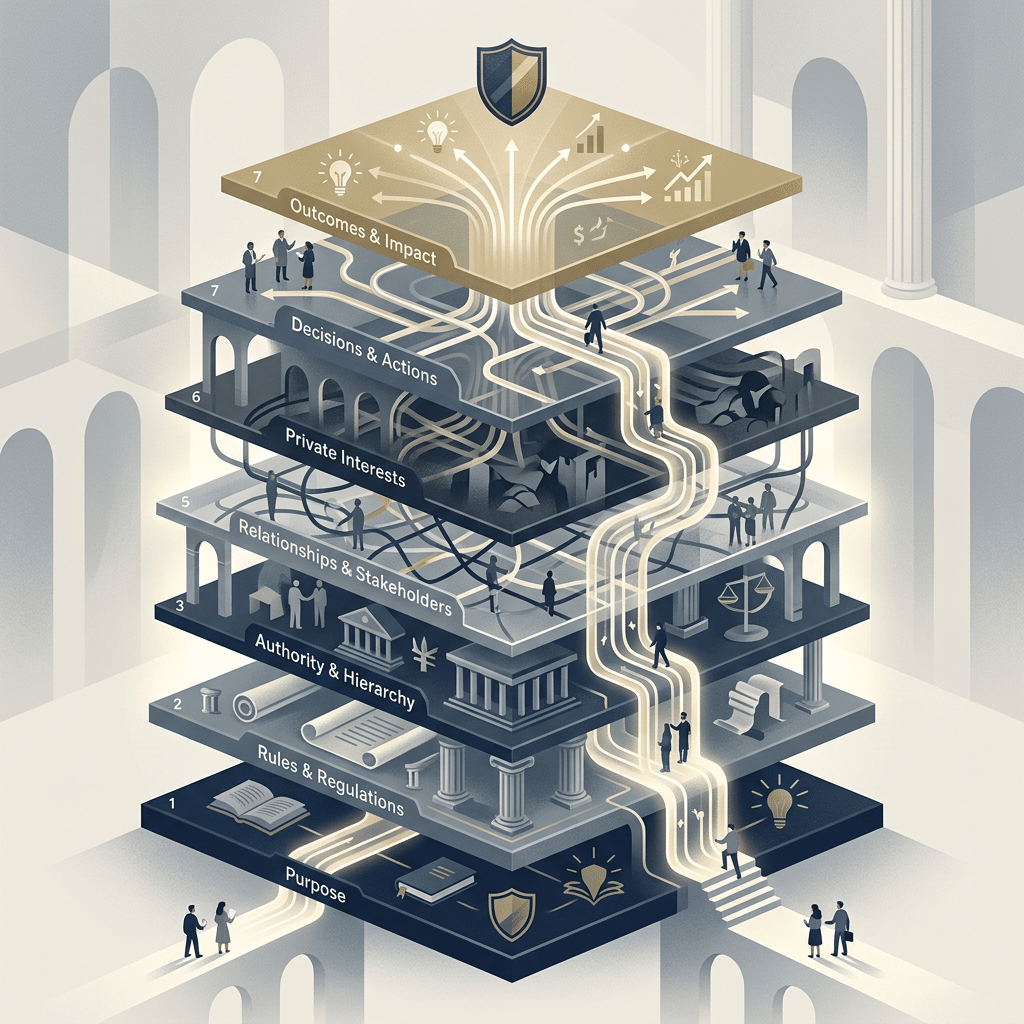
This fable satirizes an absence of equal accountability, and it illustrates how strict documentation can obscure the double standards of power. It is about governance, power, organization, leadership ethics, and critical thinking. It is about mutual responsibility and open communication. Likewise, it also connects these lessons with systems theories focusing on adaptability, interdependence, and psychological safety.
DISCLAIMER AND READER’S GUIDANCE
This information is given to develop critical thinking and articulation skills. It creates no new facts beyond those that have been independently verified or are publicly available, and it does not predict the outcome of any legal proceeding, administrative review, or investigation. Readers need to separate facts from interpretations, ethical considerations, and theoretical analysis.
This distinction highlights the difference between reality and interpretation and raises questions about research ownership and the reader’s involvement. This is not to say, however, that facts are fixed or that findings of research are predictable. The reader is invited to enter the complicated process of moral and hypothetical analysis and to consider the personal benefits of the learning experience.
LATIN PHRASE meaning
Quod Licet Iovi, Non Licet Bovi is a latin phrase meaning What is permitted to Jupiter is not permitted to the ox.
DEFINITION AND TRADITION
Double standards are when the rules are not the same. “If you are high-status (‘Jupiter’), you can do whatever you like with impunity. If you are low-status (‘the ox’), you are strictly forbidden. There is a classical tradition for the idea, and it appears in literature, notably in Eichendorff’s 1826 essay and in Terence’s Roman comedy, which contrasts divine privilege with human duty. The statement is widely used these days to point out hypocrisy. This principle is especially true when leaders or influential individuals create rules that apply to others but not to themselves.
SHORT FILMS AND CLIPS

Creator/Channel: TED-Ed
Selected for educational discussion and reflection.
The film is the property of its respective copyright holder.

Creator/Channel: TED-Ed
Selected for educational discussion and reflection.
The film is the property of its respective copyright holder.

Creator/Channel: TED-Ed
Selected for educational discussion and reflection.
The film is the property of its respective copyright holder.
THOUGHTFUL INSIGHTS
Theories of modern work systems view organizations not as static machines but as dynamic, integrated networks. They examine the interplay of technology, human behavior, and external environments. They break away from the rigid structure of classical Taylorism.
Work System Theory Framework and Life Cycle
Steven Alter’s Work System Theory (WST) treats human and machine participation in business activities as one system and not two separate systems. The Work System Framework has nine components: process, participants, information, technology, products/services, customers, environment, infrastructure, and strategies. The Life Cycle Model also looks at changes to work systems through planned and unplanned enhancements by employees.
Open Systems Theory for Business Strategy
The strategy is founded on the work of Ludwig von Bertalanffy and his view of the firm as a complex organism and, in particular, the idea of “open systems”—how companies relate to and adapt to their environment. The fundamental values are the following:
Holism: Workplace habits cannot be examined in isolation.
Interdependence: The changes in one subsystem affect other subsystems.
Feedback loops, either negative or positive, are needed for self-regulation and adaptation.
Contingency Theory in Management
Contingency theory suggests that there is no single best way to manage a work system. The best structure, the best style of leadership, and the best workflow depend on the situation. Work systems must be flexible: their internal processes must adapt to external challenges.
Knowledge Worker & Sociotechnical Frameworks
In modern management, organizations view employees as valuable assets and develop their skills. There has to be a balance between social needs (like collaboration and psychological safety) and technical needs (like software and automation).
SUMMARY OF SYSTEMS
| Theory / Approach | Core Philosophy | View of the Worker | Primary Focus |
|---|---|---|---|
| Work System Theory (WST) | Integration of human actions and technology to deliver customer value. | An active participant executing processes alongside technology. | This means aligning IT specifications directly with business strategy. |
| Modern Systems Theory | The workplace is a holistic, open organism made of interconnected parts. | It is a component of an interdependent subsystem. | Maintaining systemic equilibrium through environmental feedback. |
| Contingency Theory | Management and system structure must adapt to the situation. | Flexible contributors whose roles change based on context. | Maximizing alignment between internal processes and external demands. |
WISDOM and PHILOSOPHIES
The shift from rigid workplaces to flexible systems is paralleling the shift in modern spirituality. Modern theories of work know that the whole is greater than the sum of its parts. Spiritual stories are also about connection; they speak to the lived experience, not dogma. The main ideas suggest parallels between our way of working today and spiritual philosophies.
Systems Theory & Eastern Philosophy Parallels
Modern systems theory regards organizations as “open systems” in which change in one part affects the whole. This is akin to the oneness and interdependence in many Eastern philosophies, such as Buddhism’s Indra’s Net. An example is in forest ecosystems where trees communicate and share resources via a mycorrhizal network. Biologically and spiritually, the parts are connected, and the whole is greater than the sum of its parts. In a well-functioning organizational system, the collective supports a sick tree.
Emergent Behaviors in Work Systems
Work System Theory (WST) and systems theory study “emergent behaviors”—complex, unexpected outcomes that result from seamless interaction of people, information, and technologies. It’s like spiritual ideas of emergence or divine flow, where the mind, body, and spirit are aligned, and surprising things happen. An example is the jazz players improvising together. They go together; they make a lovely piece of music. It’s like a high-performing work team that is in alignment. They understand their instruments and the dynamics of the group.
Contingency Theory: Adaptability and Daoist Principles
According to contingency theory, the best way to manage an organization is contingent on the situation. The theory is based on principles of Daoism and modern mindfulness and is about flexibility and no rules. We see this principle in the Daoist parable The Oak King and the Willow. The yielding willow survives the storm; the unflexible oak is shattered. Peace and survival come not from fighting reality but in submission to it.
Modern Work Theories and Human-Centric Organizations
Modern theories of work address the “knowledge worker,” adding psychological safety, personal growth, and human dignity to technology. This view is in line with conscious capitalism and workplace spirituality in seeing work not only as a transaction but also as a vehicle of personal transformation. That’s the ethos at companies like Patagonia, where a sense of community exists and employees connect to their emotional and spiritual sides. The conversation moves from exploitation to enhancing the human spirit.
SUMMARY OF Conceptual Alignment
| Work System Theory | Spiritual Concept | The Shared Human Truth |
|---|---|---|
| Open Systems & Interdependence | Net of Indra / Global Oneness | “If one part suffers, the whole system suffers.” |
| Emergent Behavior | Divine Flow / Mystical Synergy | Harmony cannot be forced; it arises when elements are aligned. |
| Contingency Frameworks | Daoism / Living in the Present | Rigidity breaks; fluidity and adaptation survive. |
| The Whole-Person/Knowledge Worker | Self-Actualization / Dharma | Work is an expression of soul, purpose, and inner calling. |
RESEARCH AND ARTICLES
Alter, S. (2013). Work System Theory: Overview of core concepts, extensions, and challenges for the future. Journal of the Association for Information Systems, 14(2), 72–121. https://doi.org/10.17705/1jais.00323
Dubey, S., & Bedi, S. S. (2023). Workplace Spirituality: A Systematic Review and future Research agenda. Journal of Management Spirituality & Religion, 21(1), 83–128. https://doi.org/10.51327/cqer6430
Nishanthi, B., Hariharan, C., Babu, M., Srinivasan, S., & Anandhabalaji, V. (2025). Exploring workplace spirituality and its impact on organizational effectiveness: A bibliometric review and prospective research directions. Social Sciences & Humanities Open, 12, 101685. https://doi.org/10.1016/j.ssaho.2025.101685
Singh, R. K., & Singh, S. (2022). Spirituality in the workplace: a systematic review. Management Decision, 60(5), 1296–1325. https://doi.org/10.1108/md-11-2020-1466
Sridharan, M. A. (2026, September 9). Systems Theory of Management. Think Insights. Retrieved November 5, 2026, from https://thinkinsights.net/strategy/systems-theory-management
Susmerano, E. B. (2024). The intersection of self-determination theory and workplace spirituality: an innovative framework for advancing social work administration. Journal of Religion & Spirituality in Social Work Social Thought, 43(3), 265–279. https://doi.org/10.1080/15426432.2024.2358937
Syahir, A. N. A., Abidin, M. S. Z., Sa’ari, C. Z., & Rahman, M. Z. A. (2025). Workplace Spirituality and Its Impact on Employee Well-Being: A Systematic Literature Review of Global evidence. Journal of Religion and Health, 64(5), 3313–3345. https://doi.org/10.1007/s10943-025-02350-2
RELATED POSTS
© 2026 CLEVERPENS


Leave a Reply