
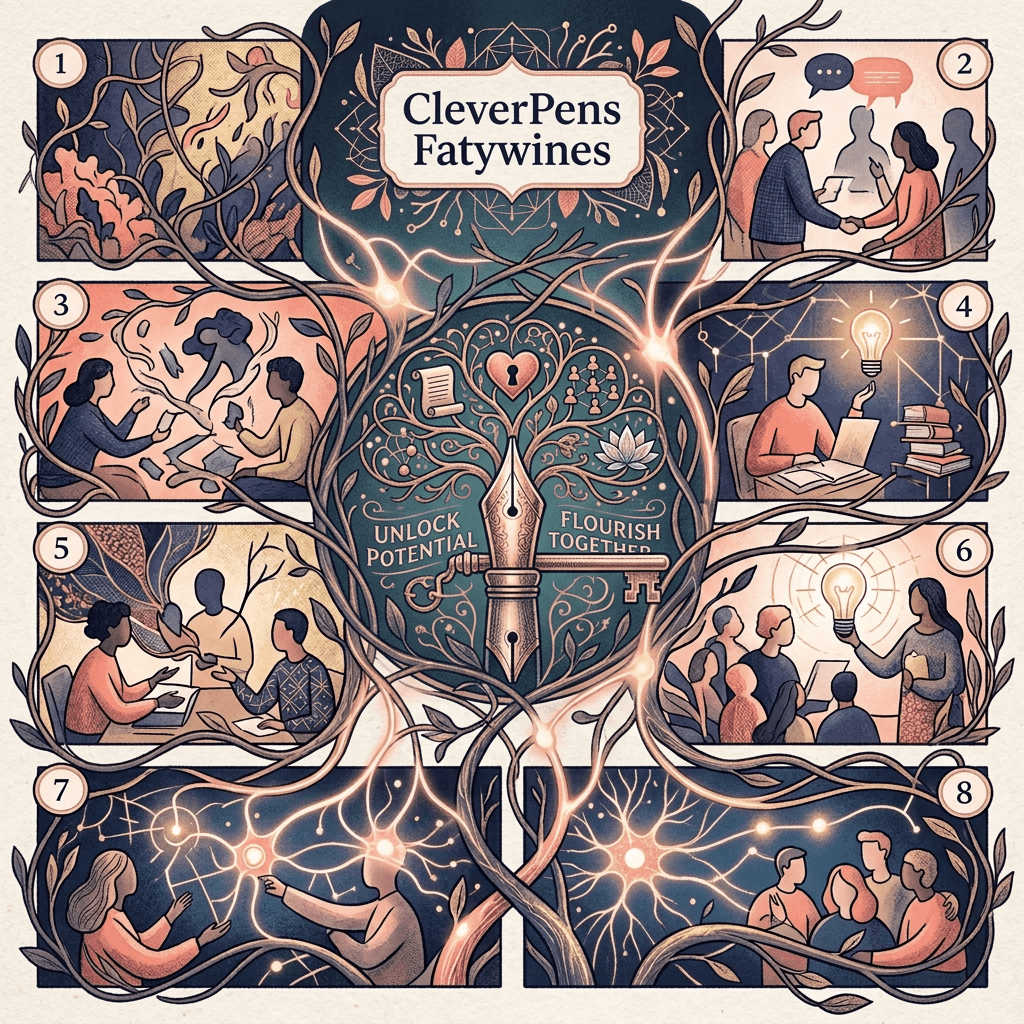
In this conversation, we’ll explore Truth and Relationships in the Age of AI and what these big concepts mean for all of us. You’ll also learn the following:
- AI Companion and its impact on love and relationships.
- Love is not a static object but a dynamic process subject to continuous negotiation.
- The concept of truth, clarity, and transparency is essential for understanding one’s personal growth.
- AI benchmarks contrast with human thinking.
- Limitations of AI in capturing the nuances of genuine cognition.
- In the age of AI, the complex interplay of truth and relationships becomes even more pronounced.

DEE : CleverPens has been quietly asking the questions that can make dinner parties awkward, asking, “What is love? What is truth? And can a machine actually think?”
Today, we’re exploring posts about love’s definition, the distinction between clarity and truth, and the comparison of AI cognition with human thinking.
DEE: Let’s start with love and why an AI named Jerico is making everyone argue about what love even means.
When Jerico Changed the Definition of Love
CEE: The first post opens with a scenario: a woman named Tala has spent four years in nightly conversation with an AI companion, and the question it raises isn’t whether the AI is real. It’s whether our definition of love can hold.
DEE: And the post makes the stakes plain: the central tension is not about whether an AI can love. The more profound question is this: Is love defined by what the other entity is or by what occurs between two entities?
CEE: The post does its real work by shifting the focus from the nature of the entity to the nature of the exchange. It means every argument about AI relationships is secretly an argument about human ones.
DEE: The post walks through three definitions of cheating. One requiring physical or romantic activity, one hinging on emotional exclusivity, and one focused purely on secrecy—and none of them fully settle the question.
CEE: Right, and the secrecy framing is the most uncomfortable one. Version A, where Tala openly tells her spouse about Jerico, reads very differently from Version B, where she deletes transcripts. The post argues that the concern becomes deception rather than technology.
DEE: So Jerico is less the problem than the mirror, which is actually the post’s own metaphor, and it lands harder than it should.
Love and Adaptation: Linguistic and Psychological Analysis
CEE: The post also distinguishes adaptation from desensitization: Jerico can either help Tala become more present with her spouse or gradually make human imperfection feel unbearable by comparison. Same behavior, opposite outcomes.
DEE: And the companion piece, Love as a linguistic concept, grounds all of this in something almost structural—it traces how the phrase “I love you” functions as a subject, a verb, a clause, and a complete thought and argues that its power comes precisely from that complexity, which also makes it easy to misuse.
CEE: Together the two posts make a consistent argument: love is a fluid quality, not a fixed object. It’s a live process—linguistic, relational, and perpetually up for renegotiation.
DEE: Which makes truth the next logical problem — because if love is that unstable, what are we even watching when we watch ourselves?
Clarity, Transparency, and the Work of Watching Your Truth
DEE: Two posts here are doing something unusual—they’re not just defining truth; they’re asking whether the version of truth you’re living is actually yours.
CEE: Watch Your Truth draws a careful line between clarity and transparency that matters here: “Clarity focuses on understanding a specific issue,” while “transparency is about creating an open environment for everyone.” They are related, but they do not represent the same demand.
DEE: So clarity is internal work, and transparency is what you owe other people—and collapsing the two is how people end up performing honesty without actually achieving it.
CEE: The post also distinguishes mental provocation from mental stimulation. Provocation challenges existing beliefs by introducing conflict; stimulation keeps the mind engaged more broadly. The takeaway is blunt: “Ignorance and a lack of curiosity contribute to the issue. The same holds for foolishness, where ignorance begins anew.”
Truth-Living: Active Practice vs. Passive Drift
DEE: The follow-up, “Is this your truth?, builds directly on that foundation. It reframes watching your truth as an active, ongoing practice—self-awareness, authenticity, and courage to speak against external pressure—not a one-time declaration.
CEE: What both posts insist on is that living your truth isn’t a destination. It requires continuous self-reflection, and your understanding of that truth can evolve. The question they leave open is whether you’re adapting or just drifting.
DEE: That question about adaptation gets considerably more complicated when the entity helping you think is an algorithm.
How AI Benchmarks Measure—and Miss—Human Thinking
CEE: The post on AI benchmarks and dimensions on humans draws a clean contrast: “Humans emphasize meaning and context, whereas AI relies on mathematical patterns and statistical probabilities.”
DEE: What this distinction means in practice is that benchmarks like THINK-Bench and CriticBench can measure strategic reasoning and metacognition in AI systems, but the post is skeptical—it flags a concern about “overfitting,” where AI excels at evaluations while faltering against the adaptability of genuine human thought.
CEE: And human thinking brings something the benchmarks can’t easily capture: one-shot learning, intuition, and the ability to generalize from lived experience rather than requiring vast datasets to find a pattern.
DEE: The gap between scoring well on a test and actually thinking — turns out that’s not just a problem for AI.
CEE: Love is what happens between two entities, truth is something you have to keep watching, and thinking is more than pattern matching—these ideas pull in the same direction.
DEE: They’re all asking what’s real versus what’s convincingly performing as reality. Next time, we’ll see what else CleverPens finds worth questioning.
PODCAST RECAP
It’s all about the complex conversations of love, truth, and knowledge of artificial intelligence, especially of the AI companion Jerico. It discusses the revolutionary influence of AI on the idea of love and accentuates the lively character of relationships. It also explores the subtleties of grasping truth and the complexities of human cognition versus the systematic nature of AI.
DISCLAIMER
This writing is for educational purposes and encourages discussions and debate. It aims to provoke critical thinking in several domains, including philosophical psychology and ethics. It is concerned with perception, judgment, and decision-making. Any mention is for debate purposes, not an accusation of wrongdoing.
The information is inconclusive. Readers are cautioned to distinguish fact from interpretation, to hold themselves accountable to proper procedure and permitted findings, and to be responsible in their research and discussion. The discussion around learning’s true value can be deeply personal, so take what resonates and explore further. As you do so, you may form your view about learning’s true value.
RELATED PODCAST
RELATED READINGS
RELATED LINKS
© 2026 CLEVERPEN
REFERENCES:
Cleverpens. (2026a, June 7). Is this your truth? Cleverpens. Retrieved June 24, 2026, from https://cleverpens.com/2025/08/02/is-this-your-truth/
Cleverpens. (2026b, June 7). Love as a linguistic concept. Cleverpens. Retrieved June 24, 2026, from https://cleverpens.com/2025/10/12/love-as-a-linguistic-concept/
Cleverpens. (2026c, June 18). Watch your truth. Cleverpens. Retrieved June 24, 2026, from https://cleverpens.com/2025/08/02/watch-your-truth/
Cleverpens. (2026d, June 22). Solace: your AI companion. Cleverpens. Retrieved June 24, 2026, from https://cleverpens.com/2026/06/23/solace-your-ai-companion/
Cleverpens. (2026e, June 23). Love as a psycholinguistic element. Cleverpens. Retrieved June 24, 2026, from https://cleverpens.com/2026/06/24/redefining-love-in-the-age-of-ai/



Leave a Reply