
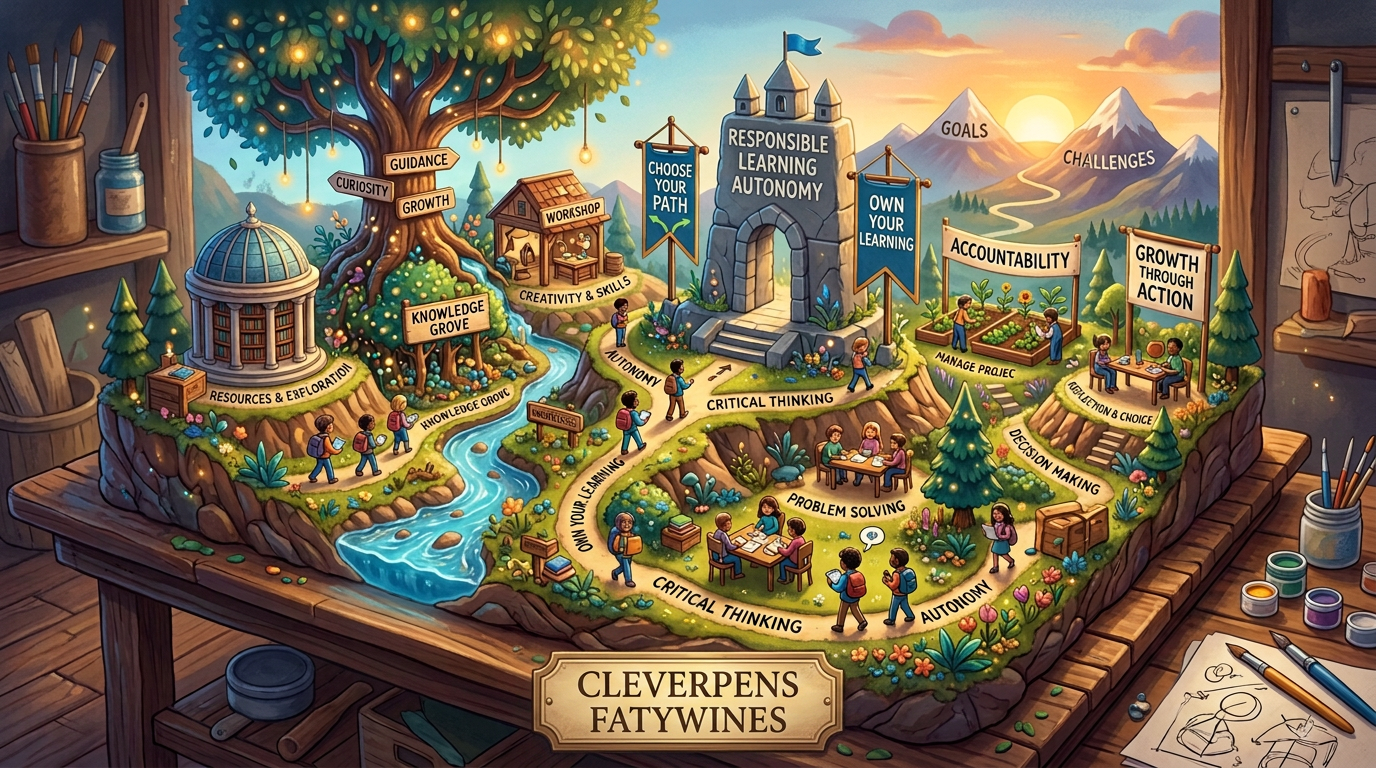
In this story, you’ll learn the following:
- The Mabini Learning Consortium is tasked to develop a learner-centered and technology-enabled educational plan.
- The keynote conversations generated significant interest. The tensions between learner agency and institutional constraints were considerable.
- Technology and assessment techniques are part of this plan.
- The school believes in a balance of control between students, teachers and the institution and a culture of inquiry and reflection.
Mabini Learning Consortium had a problem. Its schools and colleges proudly described their educational philosophy as student-centered, technology-enabled, and increasingly heutagogical. Recently, there has been growing interest in exploring depth of field in education within the consortium.
Their brochures promised the following: Independent learners. Critical thinkers. Lifelong learners.
Students were encouraged to select projects, to explore digital resources, to work together online, to employ educational technologies, and to reflect on their learning.
The institution believed it was moving beyond traditional pedagogy. But during a faculty development meeting, a teacher named Clare raised her hand. “If we’re really encouraging self-determined learning, who decides the limits?” Nobody answered immediately.
The First Crack
Clare’s Grade 10 students had access to simulations, digital libraries, videos, databases, and AI-assisted tools. The students were told, “Use technology responsibly.” But when performance tasks began, teachers prohibited several of the same tools.
A student asked, “Why can we use the simulation while learning but not when demonstrating what we learned?”
“Yes,” said the teacher. Because that would be cheating to use it. The student looked confused. “But the simulation helped me understand the lesson.”
Clare realized that the real question wasn’t whether technology was good or bad. It was: What intellectual work is the assessment supposed to measure?
If the task measured unaided procedural skill, restricting technology could make sense. If it measured analysis, synthesis, or problem-solving, the prohibition became harder to justify. The distinction was suddenly more important than the technology itself.
The Book Problem
Another student raised a different question. “If I read a book and use the author’s ideas in my paper, isn’t that also using someone else’s thinking?”
The room became quiet. Everyone knew the answer. Students were expected to use books. The difference was attribution, interpretation, and intellectual responsibility.
Clare wrote on the board: Using a tool isn’t automatically cheating.
Then underneath: What matters is what the learner delegates, what the learner contributes, and whether the contribution is honestly represented.
The AI Problem
The school then introduced an AI learning assistant. Some students used it thoughtfully. Others asked it to do their assignments. The teachers discovered something uncomfortable. The same technology could produce radically different learning behaviors.
One student said, “AI gave me the answer.”
Another said, “AI gave me three possible explanations, so I investigated which one was supported by evidence.”
Another said, “I solved it first and used AI to challenge my reasoning.”
The teachers realized that banning or permitting technology alone couldn’t tell them whether meaningful learning had occurred.
They needed to ask, “What did the student actually think?”
The Heutagogy Problem
The institution then announced, “Students are self-determined learners.” But the students learned the truth: the syllabus was set beforehand.
- Some topics were mandatory.
- Assessment schedules were set.
- The accreditation requirements had to be met.
- Technology was limited in some ways.
- The institution decided which competencies could be credited for graduation.
A student asked, “If I decide what, why, and how I learn, who decides when I’m finished?”
Another asked, “Who decides who is allowed to decide?”
The administrators realized they had encountered a much bigger issue. Learner agency existed within institutional agencies and institutional frameworks.
Heutagogy hadn’t eliminated the institution. It had made the institution’s boundaries more visible.
The Andragogy Question
At another meeting, someone observed: “Isn’t this just andragogy?” The faculty compared the concepts. Andragogy emphasized self-directed learning. Heutagogy pushed further toward self-determined learning.
The distinction seemed clear until they looked at their practices. An adult university student might choose how to study. But who decided what the student needed to study? Who decided what counted as evidence? Who decided when the student was competent? Who could change the learning goal? The boundary between andragogy and heutagogy became less like a wall and more like a continuum of agency.
The Preference Problem
Then came the most unexpected discovery. The school surveyed students. Most said, “We want more autonomy.” But the platform data showed that most students repeatedly selected the default learning pathway.
The administration concluded: “Students say they want autonomy, but their behavior shows that they prefer convenience.”
Clare wasn’t convinced. She interviewed several students. One explained: “I chose the default because I was afraid I’d choose incorrectly.”
Another said: “It was easier.”
A third said, “I compared the alternatives and decided the default was actually the best.”
Their behavior looked identical. Their reasons weren’t.
Clare wrote another sentence on the board: Revealed behavior does not automatically reveal underlying preference.
The institution had to examine the choice architecture surrounding the learner. Perhaps the system was revealing student preferences. Furthermore, it may have been revealing student uncertainty. Perhaps it was revealing the institution’s own design.
The Comfort Problem
Then another concern emerged. Some students had become dependent on technology. Why struggle through a difficult problem when an AI could explain it immediately? Why search through several sources when a summary was available? Why formulate a research question when the platform could recommend one?
The teachers realized that autonomy could produce complacency. But banning convenience wasn’t the answer either. Experts themselves use tools to reduce unnecessary effort. The real question became the following:
What cognitive work can we delegate without surrendering intellectual responsibility?
The teachers began requiring students to explain their reasoning for using specific tools. Why did you use this tool? What did you delegate? What did you independently evaluate? What changed your mind? Technology became a potential metacognitive mirror rather than merely a shortcut.
The Institutional Problem
The administration then faced a larger question. Why were institutions sometimes reluctant to adopt stronger forms of heutagogy? The faculty listed possibilities:
- Accreditation
- Standardization
- Assessment reliability
- Scheduling
- Staffing
- Credentialing
- Institutional accountability
- Financial sustainability
- The difficulty of managing highly individualized learning.
Someone suggested, “Maybe institutions are protecting their ability to earn.”
Clare responded, “Maybe occasionally. But perhaps the bigger problem is that the system itself wasn’t designed for this degree of learner autonomy.” The distinction mattered. Profit could be an incentive. But organizational inertia, risk, regulation, and scalability could also be powerful forces.
The Guardrail Problem
The faculty eventually agreed that heutagogy couldn’t mean the following: “Students do whatever they want.” They needed guardrails. But what should those guardrails protect?
They identified four:
- Safety: Don’t cause preventable harm.
- Integrity: Don’t misrepresent knowledge or intellectual contribution.
- Capability: Don’t outsource so much cognition that learning disappears.
- Accountability: Demonstrate the competencies the institution has a legitimate responsibility to certify.
Then came the harder question: Who guards the guardrails?
The Scholarship
That question became urgent when the school offered tuition discounts and scholarships to teachers who agreed to remain at the institution. The arrangement helped teachers continue their education.
Everyone benefited. The situation changed when a teacher challenged a school policy. A colleague quietly warned: “Be careful. The school paid for your master’s degree.”
Clare froze. The scholarship was supposed to support professional development. Could it now become a source of institutional leverage?
The faculty distinguished between the following: “We invested in your education, and you agreed to a reasonable service commitment,” and “We invested in your education; therefore, you owe us intellectual obedience.”
Those were not the same thing. The school could reasonably protect its financial investment. It could not simply acquire ownership over the teacher’s judgment.
The Final Meeting
At the final faculty meeting, the principal wrote five questions on the board:
WHAT: Who decides what is worth learning?
WHY: Who determines the purpose of learning?
HOW: Who determines how learning is accomplished?
WHO: Who has the authority to define legitimate knowledge and participation?
WHEN: Who decides when learning is sufficient or complete?
Nobody suggested that the institution should surrender all five. Nobody believed students should control all five. Instead, they began drawing overlapping circles.
- Institutional agency.
- Teacher agency.
- Learner agency.
- Technological influence.
- Evidence.
- Metacognition.
The circles overlapped. Sometimes they conflicted. Sometimes they reinforced one another.
The Last Question
Before leaving, Clare looked at the board. She erased everything except one sentence: “A guardrail should protect the learner without becoming a cage for the learner.”
Then she added: “But how do we know when it has become a cage?”
Nobody answered. A student sitting in the back of the room raised her hand.
“Maybe we have to keep asking.” Clare smiled.
Because that answer was incomplete. But perhaps that was the point. The institution didn’t need a permanent answer.
It needed the capacity to question its assumptions, examine its consequences, listen to the people affected by them, and revise its boundaries when the evidence demanded it.
And the students needed the same capacity. The school had begun its journey with the idea that heutagogy was about giving learners more control over their learning.
It ended up discovering something much harder:
Heutagogy also involves negotiating control responsibly—between the learner, teacher, institution, technology, and surrounding systems.
And perhaps lifelong learning begins precisely there:
Lifelong learning begins not when we have all the answers, but when we can ask better questions about the systems that shape how we find them.
DISCUSSIONS 🌱 / 🌳
Think of the whole discussion as a camera.
📷 The lens—what are we looking at?
The lens determines the field of view. We started with:
Heutagogy and technology-based learning
Then changed the lens:
learner autonomy → metacognition → institutional agency → academic freedom → bureaucracy → guardrails.
Nothing necessarily changed about the underlying educational phenomenon.
We changed the perspective through which we examined it.

🧢 The hood—what do we exclude?
A lens hood blocks unwanted light. In our discussion, a conceptual “hood” might be a boundary around the inquiry:
“We’re examining learner autonomy, not solving the entire education system.”
Without that hood, curiosity can let stray questions enter the frame.
Which is basically what happened. HAHAHA😂
It went from a classroom to a university to a learning consortium. Curiosity kept lifting the hood, though.
“But what about this?”
“And who controls that?”
“Uh oh, what happens if we move one level up?”

🧢 The cap—when do we stop?
And then there’s the lens cap. The lens cap is particularly intriguing because it doesn’t determine what the world looks like. It determines:
“We’re not photographing right now.”
That’s a surprisingly important metacognitive capability. A lifelong learner needs not only:
curiosity to open the lens
but also:
judgment about when to put the cap back on.
Otherwise: curiosity → question → question → question → question 😂
Eventually you’re photographing everything except the original subject.

And then there’s depth of field.
This might be the best part of your analogy. A camera doesn’t necessarily make everything equally sharp. You choose what belongs in focus. For our discussion, we could have:
Foreground
Heutagogy and learner autonomy
Middle ground
Technology and metacognition
Background
Institutional agency, academic freedom, regulation
Blur
Questions we haven’t investigated sufficiently yet.
That last category is important.
Blur isn’t ignorance. Sometimes it’s simply
“This isn’t the subject we’re focusing on right now.”
That is a very different epistemic posture from pretending that the background doesn’t exist. And this gives us a rather nice learning metaphor
| Photography | Learning |
|---|---|
| Lens | Perspective/framework |
| Zoom | Level of analysis |
| Aperture | Breadth/depth of attention |
| Depth of field | What is foreground vs. background? |
| Lens hood | Boundary/guardrail |
| Lens cap | Knowing when to pause/stop |
| Focus | Metacognitive attention |
| Refocusing | Revising assumptions |
| Changing lenses | Changing theoretical perspective |
| Photograph | The current interpretation |
| Raw image | Evidence before interpretation |
SUMMARY
Mabini Learning Consortium will develop a technology-enabled, learner-centered curriculum. The keynotes were popular. Learner agency clashed with institutional restrictions. It utilizes technology and evaluation. The school values inquiry, contemplation, and student-professor-institutional balance.
DISCLAIMER
This writing is for educational purposes and encourages discussions and debate. It aims to provoke critical thinking in several domains, including philosophical psychology and ethics. It is concerned with perception, judgment, and decision-making. Any mention is for debate purposes, not an accusation of wrongdoing.
The information is inconclusive. Readers are cautioned to distinguish fact from interpretation, to hold themselves accountable to proper procedure and permitted findings, and to be responsible in their research and discussion. The discussion around education’s true value can be deeply personal, so take what resonates and explore further. As you do so, you may form your own view about education’s true value.
RELATED READINGS
© 2026 CLEVERPENS. All rights reserved




Leave a Reply