
In this story, you’ll learn the following:
- Learning gaps and psychological problems due to rising demands.
- Transition to new modes of learning was a concern and a source of withdrawal.
- Flexibility from both the learners and the environment.
- This includes metacognitive adaptation and responding to students’ feedback by adjusting their teaching methods.
- Student autonomy and resilience
- Failure is an opportunity to learn and grow, not as a personal failing.

At San Aurelio Public School, teachers had discovered that many graduating students had gaps in basic skills. This chapter continues the story of the School That Knew Everyone (Part 2). The school responded enthusiastically. New diagnostics were introduced.
Students were asked to explain their reasoning, evaluate sources, interpret data, and reflect on their learning. At first, everyone was pleased. Then something unexpected happened. Some students became anxious.
Why are we suddenly being told that we aren’t good enough? ”
One student said:
I’ve been getting good grades for years. Now you’re telling me I don’t know how to learn?
Students stopped participating. Another began submitting increasingly elaborate AI-generated work. Another became obsessed with grades.
The school had identified a learning problem. But it had accidentally created a psychological problem.
The hidden cost of adaptation
For years, students had learned how to succeed within the existing system. They had developed strategies:
- Memorize what the teacher emphasizes
- Follow templates
- Reproduce expected answers
- Complete requirements
- Avoid mistakes
- Ask what will be graded
- Use familiar tools.
Those strategies weren’t necessarily irrational. They were adaptations to the environment. Then the environment changed. Suddenly the school demanded:
Think independently.
Explain your reasoning.
Question sources.
Reflect on your mistakes.
Transfer your knowledge to unfamiliar situations.
Those are valuable capabilities. But the student may experience the transition as “The rules have changed, and I’m no longer good at school.”
That can affect confidence, belonging, motivation, and willingness to take intellectual risks.
This is where homophily can amplify the problem.
Suppose teachers share an assumption: “A capable student should be able to adapt.”
Then a struggling student may hear, “If you can’t adapt, something is wrong with you.” But adaptability isn’t purely an individual trait.
It is also a relationship between the learner and the environment. A useful way to consider it is that adaptability = learner capacity × environmental support.
If the learner is expected to adapt while the environment remains rigid, the burden becomes asymmetric.
Imagine three students.
Adapter Student
- Understands the new expectations quickly.
- Asks questions.
- Experiments.
- Recovers from mistakes.
- The new system works well.
Student B: The Compensator
- He is intelligent but has weak foundational skills.
- He hides the weakness through memorization and AI tools.
- When the system demands independent reasoning, his strategy stops working.
- He becomes anxious.
Student C: The Silent Student
- She doesn’t understand the new expectations but is afraid to ask.
- She watches classmates succeed.
- She concludes, “Everyone understands except me.”
- She withdraws.
These students may receive the same instructional intervention. But they don’t experience it in the same way. That’s why equality of treatment isn’t always sufficient.
The support system needs to adapt too.
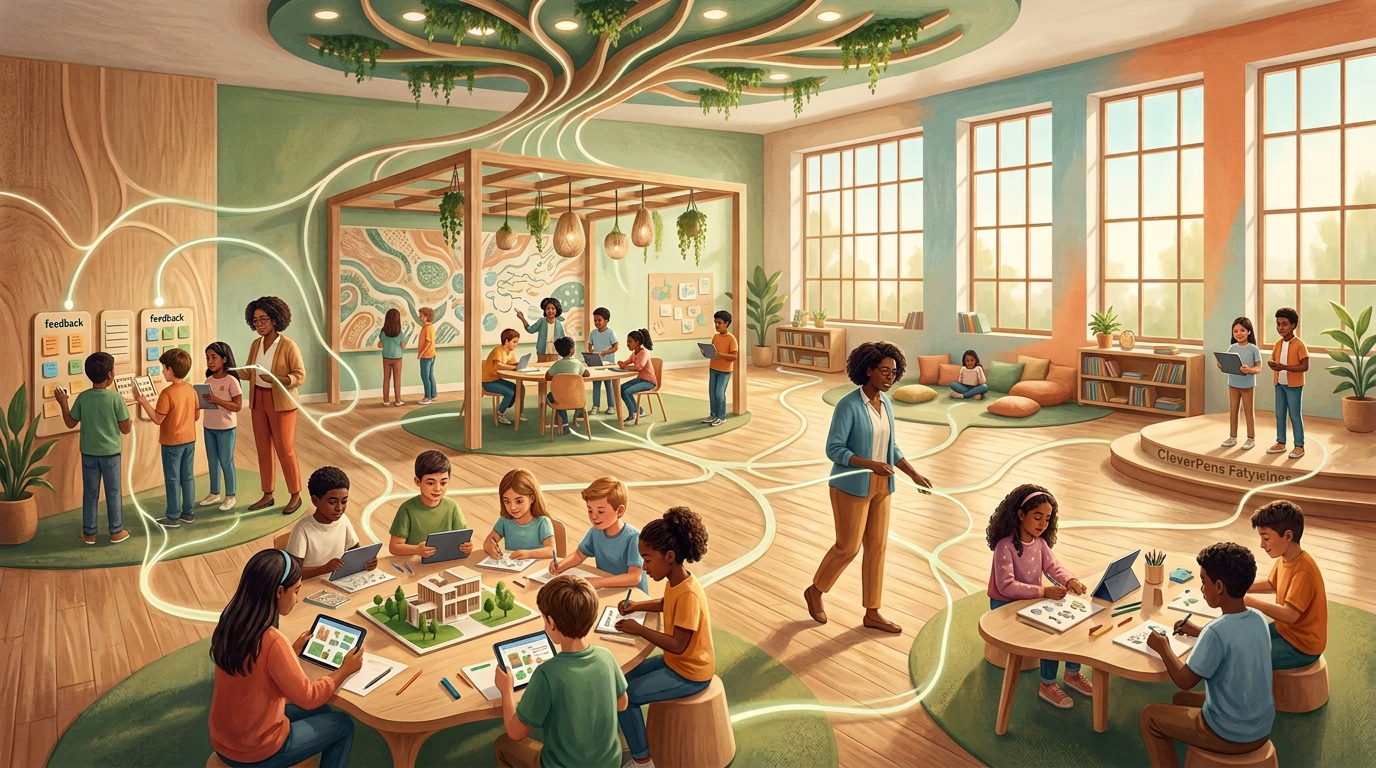
The school eventually realizes, “We cannot simply demand adaptability. We have to teach it.” So instead of saying, “Be more resilient,” teachers begin teaching how to become adaptable. Students learn:
1. How to recognize confusion: I don’t understand the material yet.
2. How to diagnose the problem: Is the problem vocabulary, prior knowledge, reasoning, or instructions?
3. How to seek help: What specific question should I ask?
4. How to use feedback: What can I change?
5. How to tolerate temporary incompetence: Not knowing something today means I can learn it later.
6. How to monitor their learning: Can I actually explain this concept without the notes?
That’s metacognitive adaptability.
Then the teachers adapt too.

This is the part I believe fits your systems perspective especially well. Instead of:
Student adapts → system remains unchanged
The school moves toward:
Student adapts ↔ teacher adapts ↔ institution adapts
For example, students struggle with reading instructions.
- → The teacher identifies the specific barrier
- → Instructional support is modified
- → Student practices the skill
- → The teacher checks whether the modification worked
- → The school examines whether other students have the same difficulty.
Now adaptation becomes reciprocal.
And this is relevant for mental health.
I’m deliberately using “mental health” broadly here rather than treating every academic struggle as a clinical condition. A learning environment can influence students’ experiences of:
- stress
- belonging
- competence
- autonomy
- confidence
- frustration
- fear of failure
- willingness to seek help.
A student who repeatedly experiences:
difficulty → judgment → shame → avoidance
can become less willing to engage. A healthier sequence is
difficulty → curiosity → support → practice → feedback → improvement
The difficulty hasn’t disappeared. Its meaning has changed.
The school also changes how it talks about failure.
Previously: You failed because you didn’t study enough.
Now: Let’s determine what this result tells us.
That doesn’t remove responsibility. It changes the student’s relationship with responsibility. Instead of “I am the problem,” the student can ask, “What part of my learning process isn’t working?” That distinction is enormously important.
And now our fault-tolerance idea returns.
Remember the system analogy? A healthy system doesn’t interpret every failure as “The component is defective.”
It investigates: What happened?
Education can do the same. When a student struggles, examine prior knowledge
- instruction
- assessment
- learning environment
- student strategy
- support
- motivation
- context
Rather than immediately assigning the entire fault to the learner. That doesn’t eliminate individual responsibility. It distributes diagnosis more intelligently.
The danger of over-support
There’s another, uh-oh, though: support can become overprotection. If teachers remove every difficulty—”Don’t worry; we’ll make it easier”—the student may never develop adaptive capacity. So the goal isn’t
low challenge + high support.
Nor:
high challenge + low support.
A healthier learning environment tries to create:
appropriate challenge + sufficient support + increasing learner autonomy.
This approach is especially compatible with the heutagogical direction being explored. The learner gradually becomes capable of determining what they need, evaluating their learning, and adapting their approach.
The case turning point.
At the end of the semester, the principal asks the students, “What helped you most?” One student says,
You stopped asking whether I was a good student.
The principal looks puzzled.
What did we ask instead?
The student smiles.
You started asking what I needed to learn next.
That becomes the school’s new principle:
Don’t merely measure whether learners can adapt to the system. Measure whether the system can adapt enough to help learners become adaptable.
And that may be the deeper connection between mental health, homophily, basic skills, and systems thinking:
Homophily can make adults normalize the same assumptions.
↓
Those assumptions can hide skill gaps.
↓
Hidden gaps eventually become visible.
↓
Sudden correction can threaten students’ sense of competence.
↓
Students may respond through anxiety, avoidance, masking, or overcompensation.
↓
A rigid system interprets those responses as student deficits.
↓
A better system asks what learner + teacher + environment each need to change.
↓
Support becomes a pathway toward adaptability and self-regulation, rather than a mechanism for making students merely conform.
The ultimate goal isn’t to create students who can tolerate any educational system.
It’s to create learners who can say:
I can encounter something I don’t understand, notice what is happening, seek the right support, change my strategy, and try again.
And an equally mature institution can say:
If many learners are struggling in the same way, perhaps we should examine ourselves too.
That’s where student adaptability and institutional self-awareness finally meet.
SUMMARY
San Aurelio Public School’s increased demands have caused learning gaps and emotional difficulties for young people. Students met expectations, but the transition to new ways of learning produced anxiety and withdrawal. The learners and the environment need to be flexible. It’s not just about asking students to be flexible. Schools should teach metacognitive adaptability and change their teaching strategies based on student input. Positive learning environments help young people to develop resilience and autonomy, and to see failure as a learning opportunity.
DISCLAIMER
This writing is for educational purposes and encourages discussions and debate. It aims to provoke critical thinking in several domains, including philosophical psychology and ethics. It covers perception, judgment, and decision-making. Any mention is for debate purposes, not an accusation of wrongdoing.
The information is inconclusive. Readers are cautioned to distinguish fact from interpretation, to hold themselves accountable to proper procedure and permitted findings, and to be responsible in their research and discussion. The discussion around life’s true value can be deeply personal, so take what resonates and explore further. As you do so, you may form your own view about life’s true value.
RELATED READINGS
RELATED LINKS
© 2026 CLEVERPENS



Leave a Reply