
Here’s what you’ll learn when you read this story:
- As learning environments change with AI, Clare’s educational experience has made her rethink the label “expert.” This is part of what inspired the Badge at the Door perspective on welcoming new ideas.
- Clare knew that research should not limit knowledge and that AI support must be considered when assessing the authenticity of writing.
- Clare chose the unknown over credentials. She opted for continued learning rather than standing still.

A Caselet on Curiosity, Changing Learning Environments, and Letting Go of Expertise
Clare had spent years in education, language, writing, and institutions. She had accumulated experiences, observations, and the usual labels that tend to follow people who remain in the field for a long time.
But she was uncomfortable with one particular label: expert. Not because expertise was bad. She simply did not want the label to become a reason to stop looking.
One evening, while exploring artificial intelligence, she encountered a learning environment that did not look quite like the one she had known before. Students could write with AI assistance. Teachers could use AI tools.
Writing assistants could correct grammar, restructure sentences, translate language, suggest alternatives, and sometimes generate entire passages.
Then there were plagiarism checkers, originality systems, AI-writing detectors, and increasingly sophisticated tools promising institutions better ways to determine whether writing was “authentic.”
The vocabulary itself seemed familiar. But the environment was different.
Clare paused. “Okay,” she thought, “I know nothing. What changed?”
The Old Question
For years, plagiarism could be approached through a relatively concrete question, “Does this text correspond to something that already exists somewhere else?“
Turnitin became associated with this kind of comparison. A similarity report could identify overlapping text. But similarity itself was not necessarily a judgment that plagiarism had occurred. Someone still had to examine the context and decide what the similarity meant.
Then generative AI changed the landscape. The question became different: Does this type of writing resemble text produced by an AI system?
That was no longer simply a source-comparison problem. It was a classification problem. And suddenly, another question appeared: “What exactly does resemblance tell us about authorship?“
Clare did not rush to answer it. She kept looking.
English Was Still English
Another realization followed. English was a language. It was not a status symbol. But English also existed in many genres and environments.
There was academic English. Scientific English. Legal English. Corporate English. Journalistic English. Technical English. Administrative English. Conversational English. And many combinations of these.
AI systems were extraordinarily capable of reproducing patterns found in language. So when someone said, “This text sounds like AI,” another possibility existed: Perhaps it sounds like a form of standardized language that both humans and AI have learned.
A student could learn a particular writing style from teachers, textbooks, journals, institutional documents, and years of schooling. An AI system could learn patterns from enormous quantities of language. Occasionally, their outputs could converge. The system did not automatically answer the question of who authored the thought.
The Writing Assistant
Clare had initially approached ChatGPT rather simply as a writing assistant, something that could help with language. If a sentence was awkward, she could ask for clarification.
If grammar was unclear, she could ask for correction. If an idea was difficult to express, she could explore alternative wording. But the more she experimented, the more important the distinction became. There was a difference between: helping someone express what they mean and creating what they are supposed to think.
That distinction mattered more than whether a machine had touched the text. A dictionary could help. Spell-check could help. A translator could help. A grammar tool could help. An AI system could help. But assistance could gradually become substitution. The important question was therefore not simply, “Did AI touch this writing?” It could also be: “What intellectual work remained with the learner?”
The Badge
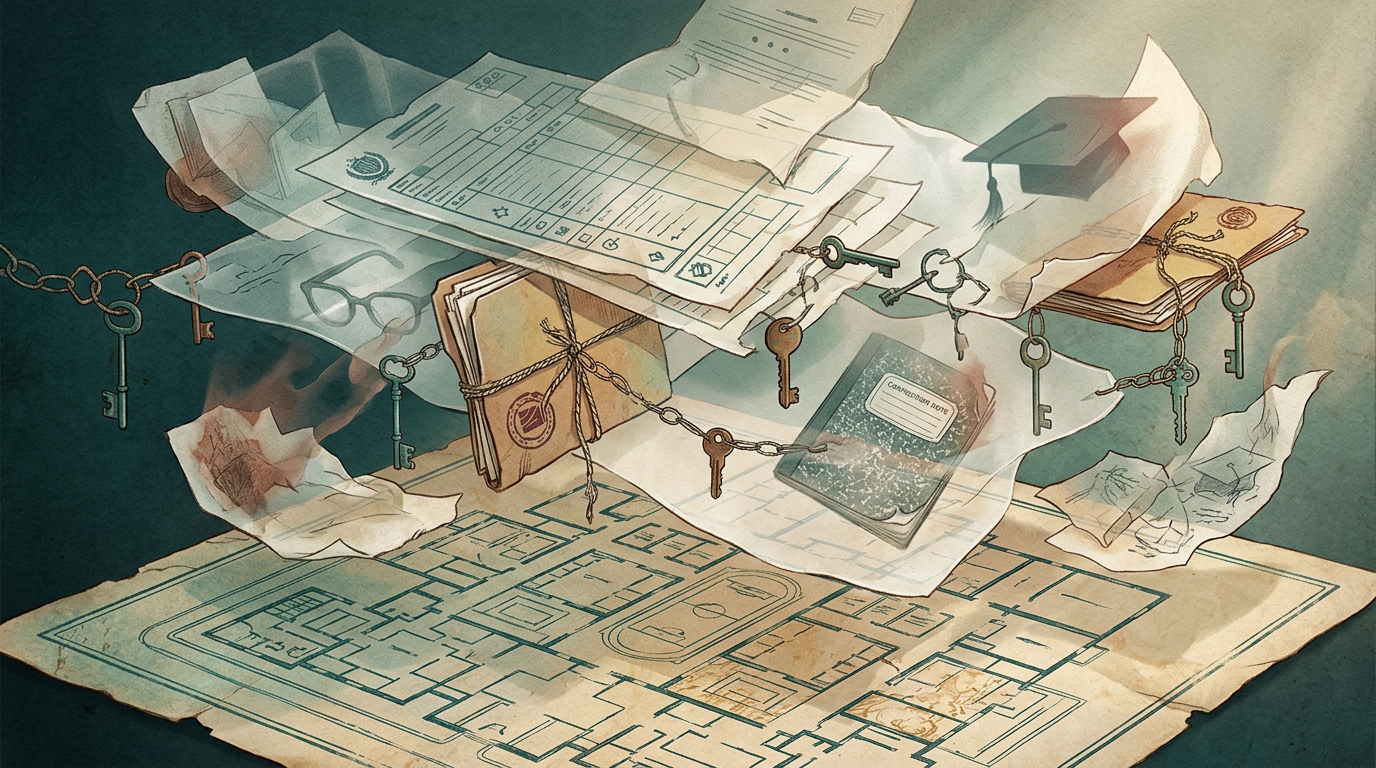
At one point, Clare noticed something uncomfortable. People often carry credentials into unfamiliar territory. Degrees. Titles. Positions. Certifications. Years of experience. Professional recognition. Badges of honor. These things can represent genuine learning. But none of them guarantees that the environment will remain unchanged.
A person can know a great deal and still encounter something genuinely new. So Clare decided that she would rather remain curious than become attached to being an expert. Not: “I already know enough.” But: “I know something. Now something has changed. What do I need to understand?”
That did not erase what she had previously learned. It simply prevented yesterday’s knowledge from becoming a permanent boundary around tomorrow’s learning.
Nothingness
Someone might have expected Clare to become an authority at this point. She refused the promotion. She preferred nothingness.
Nothingness did not mean ignorance as an excuse. It meant beginning without the obligation to defend a reputation. Nothingness could ask:
- What exactly is plagiarism?
- What does similarity actually establish?
- What does an AI-detection score actually establish?
- What does “authentic writing” mean?
- Where does language assistance end and intellectual substitution begin?
- What evidence shows that someone learned?
- What changed in the learning environment?
And perhaps the most important question: What else is there to learn?
The Decision Point
A university committee is considering how to respond to AI-assisted writing. It can:
- Invest primarily in increasingly sophisticated detection tools.
- Use detection tools as limited signals while retaining human judgment.
- Redesign parts of assessment so that learning is demonstrated through drafts, explanations, revisions, source evaluation, discussion, demonstrations, and other evidence of the learner’s process.
The committee does not have to choose between technology and human judgment.
Its deeper decision is about what evidence it considers meaningful when the learning environment has changed.
Discussion Questions
- What changed when generative AI entered an environment previously organized around conventional writing and plagiarism detection?
- How does source similarity differ from AI-generated text detection?
- When does language assistance become intellectual substitution?
- Can a student produce highly standardized academic English without using AI? What does that imply for judgments based solely on writing style?
- What can a detector tell an institution—and what can it not tell an institution?
- What forms of evidence might demonstrate that a learner actually understands their work?
- What is the value of retaining expertise while remaining willing to become a beginner again?
- What might happen to learning when people become more concerned with protecting their credentials than understanding a changing environment?
- If English is a language rather than a status symbol, how might that change the way we interpret differences in students’ writing?
- What becomes possible when a learner can say, “I know nothing. Let me look again?”
TAKEAWAYS
The case asks learners to examine learning as an ongoing process rather than a permanent status, particularly when technology changes the environment in which knowledge, language, writing, and assessment operate.
The intended lesson is not that expertise is unnecessary. It is that expertise and curiosity do not have to be enemies.
A person can know much and still ask questions. A person can hold credentials and still learn. A person can have experience and still say, “I don’t understand this yet,” and perhaps that is where learning something genuinely new begins.
DISCLAIMER
This writing is for educational purposes and encourages discussions and debate. It aims to improve critical thinking in several domains, including philosophical psychology and ethics. It is concerned with perception, judgment, and decision-making. Any mention is for debate purposes, not an accusation of wrongdoing.
The information is inconclusive. Readers are cautioned to distinguish fact from interpretation, to hold themselves accountable to proper procedure and permitted findings, and to be responsible in their research and discussion. The discussion around learning’s true value can be deeply personal, so take what resonates and explore further. As you do so, you may form your view about learning’s true value.
Don’t miss out on these
© 2026 CLEVERPENS



Leave a Reply