
In this story, you’ll learn the following:
- Environmental researcher Clare compares the water use of an AI data center with the water use of humans.
- She finds that comparing the water used for cooling a data center to household water usage is asymmetrical.
- Just because a data center is water efficient doesn’t mean it’s ecologically responsible. Availability and ecological consequences are important.
- Engineers recommend holistic monitoring of the watershed conditions and not just internal measurements.
- The case study indicates that ethical use, whether human or industrial, necessitates an understanding of the entire water system.
When Clare, a young environmental researcher, heard that a proposed AI data center would be built near a major Philippine water system, her first reaction was immediate: “Another giant facility competing with people for water.”
The project developer presented a different picture. Their engineers explained that the facility would use highly efficient cooling, monitor every liter entering the site, maximize recycled water, and reduce potable-water consumption. Its water usage effectiveness was expected to be substantially better than older facilities.
Clare frowned. “So you’re saying the data center is more responsible with water than humans?”
The chief engineer paused. “No. We’re saying we can measure our consumption more precisely.”
That distinction bothered Clare.
The first blind spot: the consumption fallacy
Clare compared the facility’s projected water consumption with household consumption. The numbers looked alarming. Thousands of people versus one building. But her colleague Jayme interrupted. “Wait. What are you comparing, exactly?
Clare pointed to the figures. “Liters consumed.” “Consumed for what?” “Cooling.” “And humans?” “Drinking, cooking, washing…”
Jayme smiled. “So we’re comparing thermal management with biological life.”
The comparison wasn’t necessarily useless. But it wasn’t symmetrical either. The human body consumes water because it is a biological organism. The data center consumes water because engineers have chosen a particular method of removing heat. That meant some of the data center’s water demand could potentially be redesigned. The human body’s water requirement cannot be redesigned.
The second blind spot: the efficiency fallacy
The developer proudly showed Clare its WUE (Water Usage Effectiveness). It was impressive. “Excellent,” Clare said. “You’ve solved the water problem.” The engineer shook his head. “No. We’ve improved one metric.”
Clare looked puzzled. He drew three boxes.
- Water efficiency.
- Water availability.
- Ecological impact.
“They aren’t the same thing.” The engineer clarified.
A data center could use very little water per unit of computation and still locate itself in a severely water-stressed watershed. Conversely, another facility could consume more water but use reclaimed wastewater in a region with abundant supply.
Clare suddenly realized the following:
- A low number on the meter does not automatically mean a low ecological burden.
- Efficiency had become a proxy for responsibility.
- The proxy was beginning to masquerade as the thing itself.
The third blind spot: the boundary fallacy
The engineers showed Clare the facility’s water meter. “Everything entering the building is accounted for.” “Wonderful,” she said.
Out of curiosity, Clare asked, “But where did the water come from?”
“The municipal system,” the engineer said
Clare’s clarificatory question was, “And before that?”
“The reservoir,” the engineer said
Clare asked in a smiling voice, “And before the reservoir?”
“The watershed,” the engineer grinned.
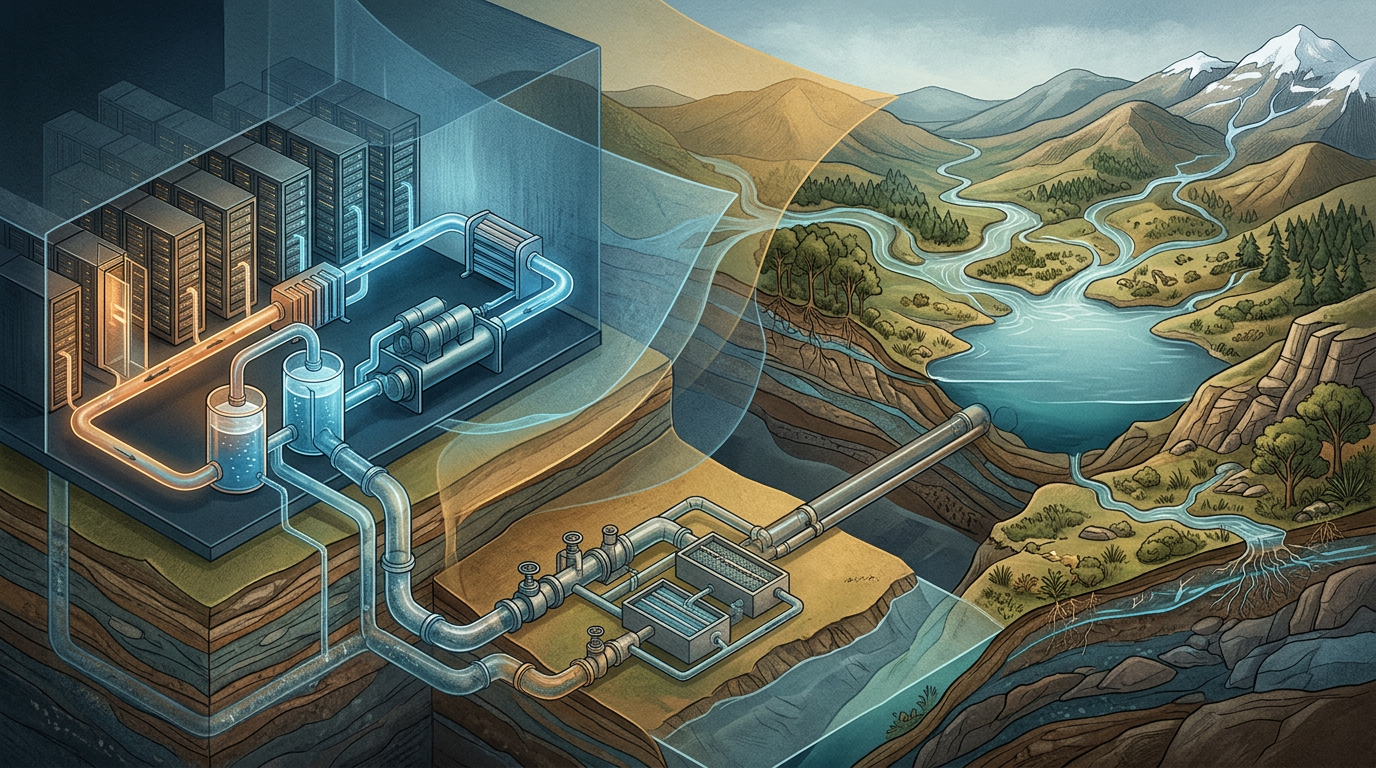
Clare stopped. The meter suddenly looked tiny. The data center could precisely measure what happened inside its fence. But the watershed did not recognize that fence. Rainfall, groundwater, reservoirs, rivers, agriculture, households, and ecosystems connect, whether or not the accounting system acknowledges them.
Clare recorded her observations in her notebook. The system boundary can create the illusion of control.
Then came the drought.
Six months later, rainfall was substantially below expectations. Reservoir levels declined. The utility issued conservation advisories. Farmers became concerned about irrigation. Households were asked to reduce consumption. The data center was still operating normally.
Clare returned to the facility. “You said your cooling system was resilient.”
“It is,” the engineer said.
Clare asked, “Even during drought?”
The engineer hesitated and said, “Technically, yes.”
Clare looked toward the reservoir. “That’s not what I asked.”
For the first time, the engineers recognized the missing variable. Their system had excellent thermal resilience. But did it have watershed resilience?
The Paradox of Adaptation
The company proposed switching to alternative cooling. That would reduce freshwater consumption. But it would increase electricity demand. The electricity system itself had a water footprint. Reducing water locally could therefore increase water use somewhere upstream.
Clare laughed quietly. “Every time we solve the water problem, it moves.”
Jayme corrected her, “Not necessarily.”
Clare looked at Jayme and said, “What do you mean?”
“We’ve been asking where the water is used,” Clare smiled and pointed toward the watershed. “We should ask where the burden moves.”
The problem wasn’t simply consumption. It was displacement.
The human mirror
Clare started to examine her household. She discovered something uncomfortable. Clare was dumbfounded that she could criticize the data center for consuming water when she herself had never calculated her own water use.
- Water lost through municipal leakage
- Water used to produce her food
- Water used to generate her electricity
- Water embedded in manufactured products
- The ecological consequences of her consumption.
She had been comparing the data center’s measured footprint with her own unmeasured footprint. Her judgment had been asymmetrical. She wasn’t necessarily wrong about the risk. But she had been measuring one system with a microscope and the other with intuition.
The final meeting
The developer eventually proposed a new operating rule. The data center would not merely monitor its WUE.
It would monitor watershed conditions. When water stress crossed predetermined thresholds:
- Cooling strategies would change
- Potable-water dependence would decrease
- Reclaimed water would be prioritized
- Nonessential water demand would be reduced, and
- The facility would coordinate with the relevant water authorities.
Clare looked at the proposal. “So you’re making the watershed part of the feedback loop.”
The engineer nodded and said, “Exactly.”
Clare smiled. “Now you’re managing water.”
What the case study exposes
The central tension wasn’t humans vs. AI. It was consumption vs. context.
Several assumptions had quietly entered the original argument:
| Bias/fallacy | Hidden assumption |
|---|---|
| Anthropocentric bias | Water matters primarily because humans need it. |
| Technological optimism | Better cooling automatically solves the environmental problem. |
| Efficiency fallacy | Less water per computation = greater ecological responsibility. |
| False equivalence | Human biological consumption and industrial cooling are interchangeable. |
| Boundary fallacy | What happens inside the facility represents the entire water footprint. |
| Metric fixation | What can be measured is what matters most. |
| Moral licensing | Being efficient justifies consuming the resource. |
| Zero-sum framing | Data centers and humans must necessarily be competing for the same water. |
| Rebound paradox | Reducing water use can increase energy demand—and potentially upstream water use |
| Ecological blindness | Water available to humans is assumed to be water available to ecosystems |
And underneath all of them is one particularly seductive assumption: “If the system is efficient, the system must be sustainable.” That’s the paradox!
The epistemic twist
Clare began the case thinking: “Data centers consume water; therefore, they’re a threat.”
She ended with, “Data centers consume water; therefore, I need to understand the entire system connecting their consumption to the watershed.”
The conclusion didn’t become pro-data center. It became more difficult to classify. And that’s precisely why the case is useful for learning.
The learner isn’t asked to choose: human OR data center.
They’re asked to notice: consumer → infrastructure → resource → feedback → adaptation → ecological consequence.
The deepest question is: when does an efficient consumer become an irresponsible consumer?
Perhaps the answer is, “When its definition of efficiency becomes narrower than the system it depends on.” And conversely, when does consumption become responsible?
Not necessarily when consumption reaches zero—but when the consumer can recognize constraints, adapt to them, account for displaced burdens, and remain answerable to the larger system that sustains it. That makes the data center a rather beautiful metacognitive mirror for humans: we may discover that our respective water consumption is not necessarily more responsible simply because it is natural.
TAKEAWAYS
Clare is an environmental researcher. She’s researching how the water use of an AI data center compares with humans. “There are a lot of misconceptions about efficiency and ecological responsibility,” she says, citing the importance of looking at water systems holistically. Clare finally finds that true sustainability is about understanding the interconnected nature of consumption, context and environmental impact.
DISCLAIMER
This writing is for educational purposes and encourages discussions and debate. It aims to provoke critical thinking in several domains, including philosophical psychology and ethics. It is concerned with perception, judgment, and decision-making. Any mention is for debate purposes, not an accusation of wrongdoing.
The information is inconclusive. Readers are cautioned to distinguish fact from interpretation, to hold themselves accountable to proper procedure and permitted findings, and to be responsible in their research and discussion. The discussion around education’s true value can be deeply personal, so take what resonates and explore further. As you do so, you may form your own view about education’s true value.
© 2026 CLEVERPENS. All rights reserved



Leave a Reply