
This story explores The Village That Copied the Library and the lessons it offers. Likewise, you’ll learn the following:
- The village built an open library in the town of Many Pages.
- Anyone could take any article for free.
- But when engineers built a machine that could cut and paste text, a war over ownership and rights broke out.
- At some point, villagers understood that access is not ownership and started to think again about the ethics of mass copying.
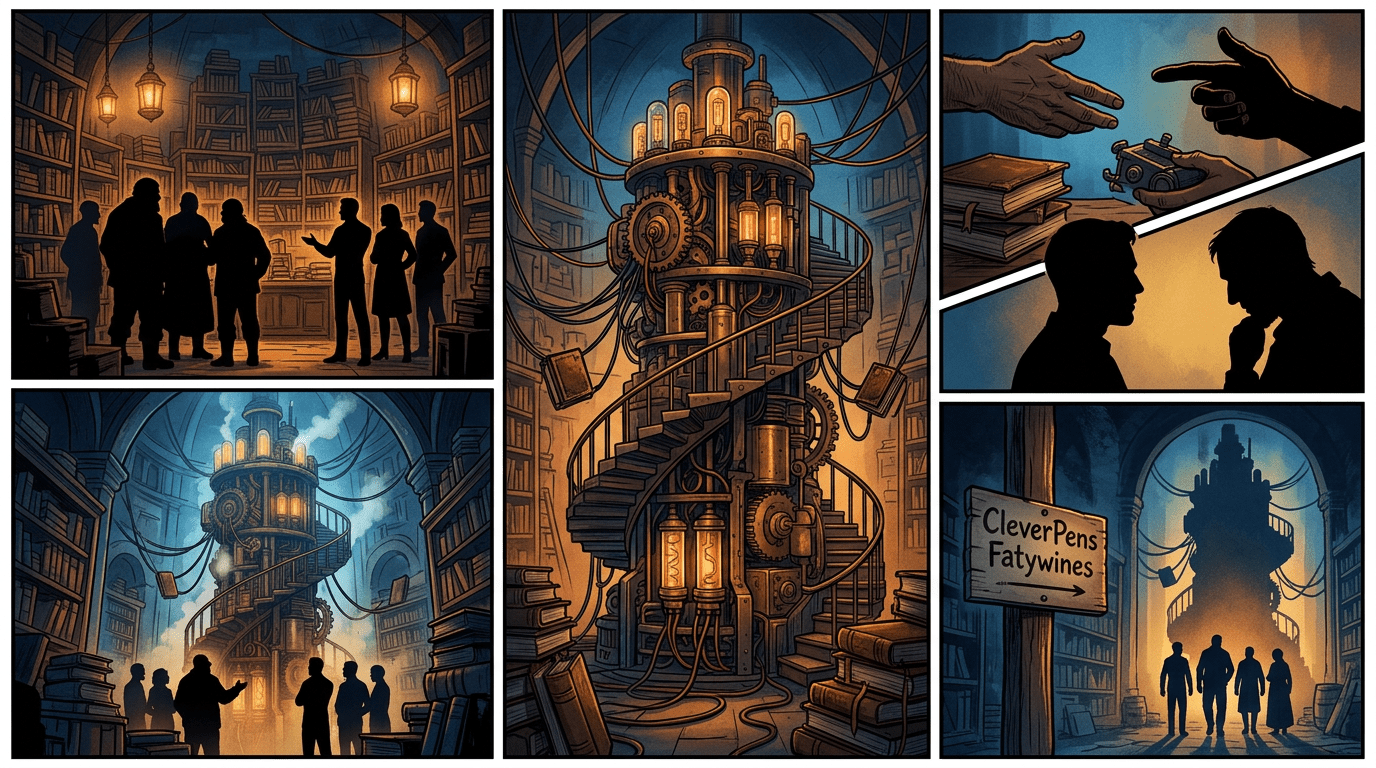
Long ago, in a village called Many Pages, there stood a library without walls. This is the beginning of the tale known as The Village That Copied the Library. Anyone could walk through it. Its shelves stretched across the roads, the houses, the marketplace, and even beyond the village gates. Some shelves held stories. Others held drawings, songs, recipes, maps, letters, lessons, and carefully written instructions.
The villagers called it the Open Library. Nobody thought much about the strange little machines that visited the library at night.
The machines had one job: Look. Record. Return.
They copied the titles and contents of the shelves so that another machine could help villagers find what they were looking for. The villagers accepted this arrangement. After all, the machines were useful.
A baker could search for recipes. A child could find a story. A scholar could locate an old manuscript. A traveler could search for a map. Nobody called the machines thieves.
Then the Machines Learned
One winter, a group of engineers arrived. They built a new kind of machine. Instead of merely remembering where things were, it could study enormous quantities of material and learn patterns from them.
So the engineers fed it books, then articles. Then drawings. The conversations. Then code. Then photographs.
The machine became remarkably adept at producing new things. “Look!” cried the engineers. “It can write a story.” “Explain mathematics.” “It can draw a picture.” “It can write code.”
The villagers were fascinated. But one evening, a librarian discovered something troubling. She found a familiar passage in a collection that had been used to build the machine.
Then another. Then another.
She asked, “Who gave the machine permission to study these?”
Nobody had a simple answer.
Some materials had been licensed. There are those that had been freely shared. Some came from public sources. Some had uncertain ownership. And some, people discovered, had originally come from places where unauthorized copies of books were circulating.
The librarian looked at the enormous machine. Then she looked at the library. And she asked the question that divided Many Pages:
“If something can be reached by everyone, does that mean everyone has the right to take it?”

The Engineers Answered
“We did not steal your books,” said one engineer. “We copied information so that the machine could learn patterns.” Another engineer added: “Humans read books and learn from them. Why shouldn’t machines?”
The librarians disagreed. “A human reading one book is not the same as a machine processing millions of works at an industrial scale.”
The engineers replied, “But copying during computation does not necessarily mean the machine contains every book.”
The librarians answered, “But the machine was built from the books.”
The argument grew louder. Soon the villagers began using a new word: THEFT. It was a powerful word and simple to understand. It was also much easier to say than “We are disputing the legal and economic consequences of large-scale copying, dataset acquisition, model training, copyright, licensing, transformation, and market substitution.”
The village chose the shorter word, “theft.”
The Old Librarian’s Question
An old librarian had been listening quietly.
She finally stood and said, “Perhaps,” she said, “we have mixed together several different questions.”
The villagers became silent. She wrote five questions on the library wall:
- Where did the material come from?
- Was it obtained lawfully?
- Who gave permission to use it?
- What was done with it, exactly?
- Who benefited—and who bore the cost?
Then she added a sixth: Can we prove the answers?
Nobody spoke. The engineers looked at the librarians. The librarians looked at the engineers. The villagers looked at the machines.
For the first time, they realized that “scraped” was not an answer to any of those questions. It merely described how the material had been collected.
The Library’s New Sign
Years later, the village replaced the old sign above the entrance. It no longer said, “EVERYTHING HERE IS FREE FOR EVERY PURPOSE.”
Instead, it said, “ACCESS IS NOT THE SAME AS OWNERSHIP.”
Underneath it, someone added another line: COPYING IS NOT THE SAME AS THEFT.
And beneath that, the old librarian quietly wrote, “But sometimes copying can become a dispute about rights, permission, harm, and power. Find out which one you are looking at.“
The villagers never completely agreed. But they had learned something more valuable than agreement.
They had learned to ask, “What actually happened?”
Before asking, “What should we call it?”
Discussion Questions
- At what point in the story did ordinary web crawling become a social controversy?
- Is publicly accessible the same as public domain? Why might that distinction matter?
- Does copying something automatically mean that the copier has stolen it?
- Does the scale of copying change the ethical question?
- How does the source of the material change the analysis?
- What difference does it make if the material was:
- licensed,
- publicly accessible,
- copyrighted but lawfully obtained, or
- obtained from an unauthorized source?
- Why might “mass theft” be rhetorically powerful even when the underlying legal question is more complicated?
- What information would you need before deciding whether a particular AI-training practice was legitimate, questionable, or unlawful?
- Who should bear the burden of establishing provenance: the creator, the dataset builder, the AI developer, or someone else?
- What did the villagers almost miss by arguing about the word “theft”?
The Little “Uh-Oh” Question
Suppose the engineers say, “We didn’t copy your work to sell copies of it. We used it to build something new.”
Suppose the librarians answer, “But you needed our work to build the new thing.”
Does either statement, by itself, settle the dispute? Why or why not?
DISCLAIMER
This writing is for educational purposes and encourages discussions and debate. It aims to improve critical thinking in several domains, including philosophical psychology and ethics. It is concerned with perception, judgment, and decision-making. Any mention is for debate purposes, not an accusation of wrongdoing.
The information is inconclusive. Readers are cautioned to distinguish fact from interpretation, to hold themselves accountable to proper procedure and permitted findings, and to be responsible in their research and discussion. The discussion around learning’s true value can be deeply personal, so take what resonates and explore further. As you do so, you may form your view about learning’s true value.
Don’t miss out on these
© 2026 CLEVERPENS


Leave a Reply