
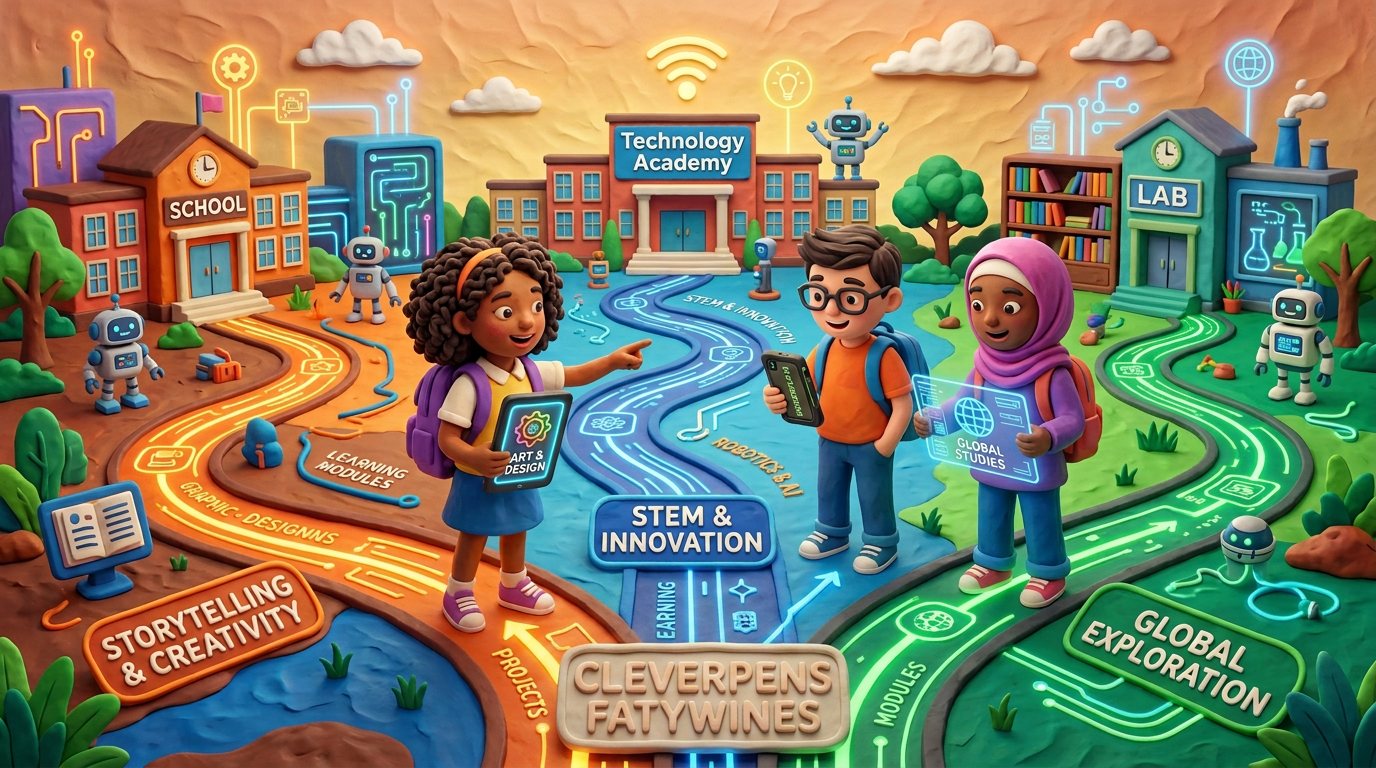
In this story, you’ll learn the following:
- Students at FWJ Learning Academy used Pathfinder, a digital learning platform that offers personalized ideas and feedback.
- When using technology, student Jayme, although he enjoyed immediate help, found it difficult to see how he was making his decisions.
- Fatima questioned Pathfinder’s advice and shared her knowledge of the importance of multiple sources in learning.
- Teachers altered the use of the platform to promote metacognition, encouraging students to reflect on their learning tactics and decisions.
- The event demonstrated the balance between the use of technology and the development of metacognitive agency in learners.
Digital Learning Platform Pilot
Students ages 13-19 at FWJ Learning Academy got a first look at Pathfinder, a new digital learning platform. The platform could suggest resources, give instant feedback, record mistakes, and even recommend what the students should study next. The platform could suggest resources, provide instant feedback, track mistakes, and even recommend what students should study next.
The school administration was ecstatic. “This platform will make learning personal for everyone. Teachers initially agreed.
One Grade 8 student, Jayme, loved it. If he got stuck on some tricky math problem, Pathfinder would immediately give Jayme a hint. Pathfinder would immediately provide Jayme a hint if he had a challenging math problem. Tip him off right away. If it was still challenging, the answer was obvious. He scored better.
But in a reflection activity, his teacher, Ms. Winclare, asked, “How did you know which strategy to use? Jayme paused and said, “The system told me.”
Ms. Winclare asked another question, “What would you do if Pathfinder weren’t available?” Jayme laughed. “I don’t know,” the student said.
AI Research Bias in Pathfinder
Meanwhile, seventeen-year-old Fatima had a different experience. She was looking at whether artificial intelligence improved students’ learning. Pathfinder recommended several articles supporting the idea.
Fatima accepted them at first. Then she noticed something strange: nearly every recommended source seemed to reach a similar conclusion. She didn’t just take the recommendation on board; she looked elsewhere. She found studies raising different concerns. Fatima returned to her teacher. “Why did Pathfinder keep giving me sources that all agreed with each other?”
Ms. Winclare said, “That’s an intriguing question. How do you feel?
Fatima thought for a moment. “Maybe the system isn’t showing me the whole landscape. Maybe I need to understand how it decides what to recommend.” Her original research question changed. She was no longer simply asking, “Does AI improve learning?” She was asking, “How does the technology influence what I believe I know about learning?”
The Turning Point
The teachers eventually noticed something. The students with the highest platform scores weren’t necessarily the students demonstrating the strongest metacognition. Some students had become extremely efficient at following Pathfinder’s recommendations. They knew what to click next. But they didn’t always know:
- why they made a particular decision
- why they misunderstood something
- when a source was unreliable
- Which learning strategy worked for them?
- or when they should abandon a strategy
The school changed the design. Instead of Pathfinder automatically giving students the next step, students were sometimes required to pause before receiving assistance. A mathematics student might first answer, “What do I already know? Then, what am I trying to find out? After attempting the problem, what caused my difficulty? After receiving feedback, do I agree with it? Why or why not? And finally, what will I change the next time I encounter a similar problem?
The technology hadn’t disappeared. Instead, the relationship between the learner and the technology had changed.
The Heutagogical Shift
By the following semester, teachers noticed another change. Thirteen-year-olds still needed considerable scaffolding. Fifteen-year-olds were beginning to explain why they selected particular strategies. Seventeen-year-olds were questioning the assumptions behind their strategies. Nineteen-year-olds were increasingly designing their own learning projects.
The teachers were gradually moving from the traditional model, “Here’s what you need to learn,” to “Here’s a problem. How might you investigate it?”
And eventually, “What do you think you need to learn next?”
The students were not simply becoming better users of technology. They were becoming better observers of themselves as learners.
The Caselet’s Central Tension
The school began with the belief that more technology and more personalization were better for learning. However, the experience demonstrates something more subtle. More technology can lead to greater reliance unless learners develop metacognitive agency.
Technology can provide feedback, access, simulation, and cognitive support. Student-centered learning provides learners with voice and choice.
Heutagogy advances the concept further. The learners can progressively determine, evaluate, and redesign their learning process. And it is metacognition that allows it. The students are left to decide the question.
At the end of the semester, Ms. Winclare gave the class one final question:
If the technology disappeared tomorrow, would you still know how to learn?
Jayme smiled.
Fatima looked at her notebook.
Neither answered immediately.
For the first time, however, the pause itself became part of the lesson.
SUMMARY
The learning was delivered via the Pathfinder digital platform for students of the FWJ Learning Academy. Jayme found that useful. But Fatima desired more information than the technology could provide. Fatima curiously uttered, “How important is critical thinking? The teachers reworked their story to include metacognition and self-awareness during the course of learning.
TAKEWAYS
Heutagogy fits perfectly with technology-based learning and student-centered learning. However, the main difference is that technology is an enabler, not a source of learner autonomy. Heutagogy is self-determined learning. The student is in control of what, why, and how to demonstrate what they have learned. I wonder who controls the “who” and “when.” It is a question of institutional agency and how it affects systems.
DEFINITION OF TERMS
Heutagogy: Student Learning Progression in Inquiry-Based Education
DISCLAIMER
This writing is for educational purposes and encourages discussions and debate. It aims to provoke critical thinking in several domains, including philosophical psychology and ethics. It is concerned with perception, judgment, and decision-making. Any mention is for debate purposes, not an accusation of wrongdoing.
The information is inconclusive. Readers are cautioned to distinguish fact from interpretation, to hold themselves accountable to proper procedure and permitted findings, and to be responsible in their research and discussion. The discussion around life’s true value can be deeply personal, so take what resonates and explore further. As you do so, you may form your own view about life’s true value.
RELATED READINGS
RELATED LINKS
© 2026 CLEVERPENS. All rights reserved




Leave a Reply