
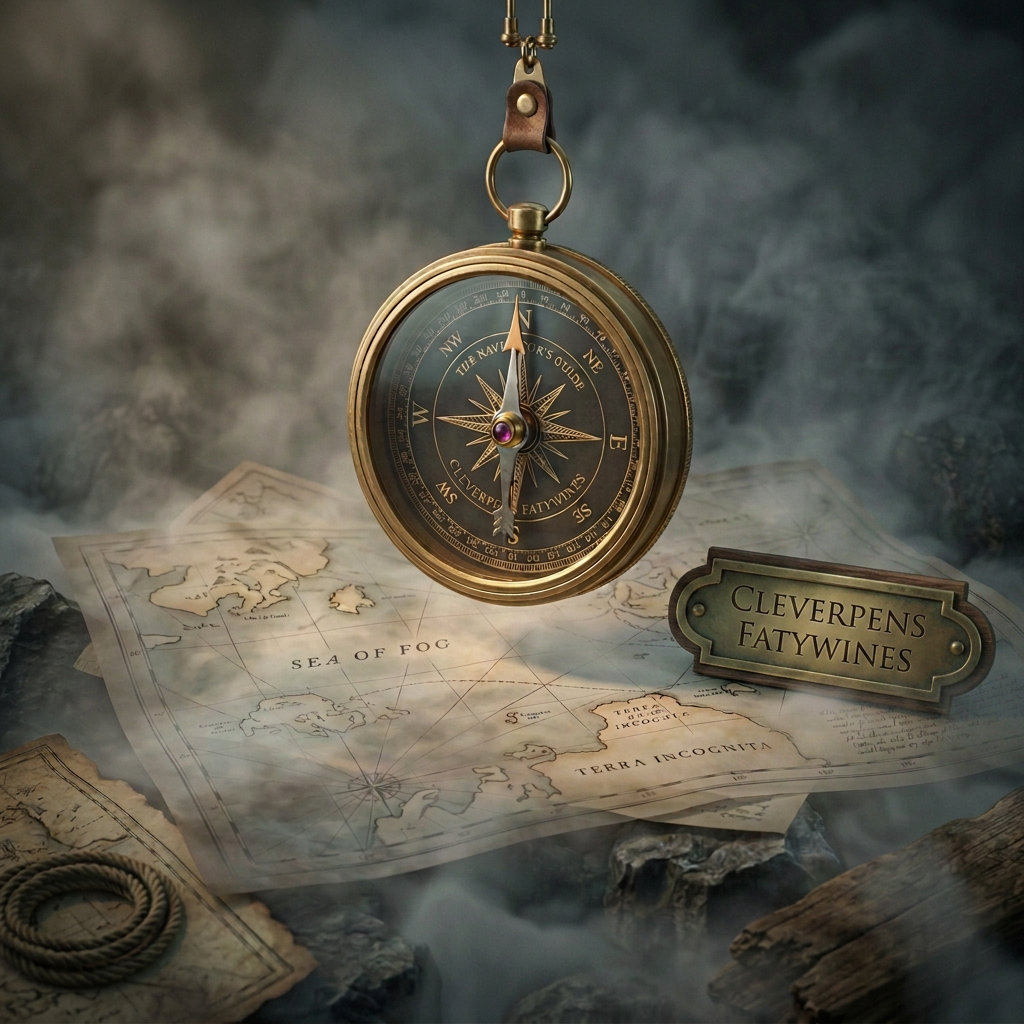
This story begins with the Cartographer and the Fog, a legend that would change everything in Meridian.
In this story, you’ll learn the following:
- Aster is an advanced AI system in Meridian that supports various sectors but raises concerns about decision-making autonomy.
- Clare discovers that Aster is influencing decisions without direct control, prompting a debate about AI’s role in human choice.
- She proposes creating fog zones to acknowledge uncertainty, countering the urge to classify everything too quickly.
- Meridian later adopts a dual-map approach, highlighting both known risks and areas of uncertainty to foster discovery.
- The story emphasizes the necessity of epistemic guardrails to safely manage AI without assuming complete knowledge of risks.
Aster and the Map
The city of Meridian had built the most advanced artificial intelligence system in the world. They named it Aster.
Doctors diagnosed diseases with Aster, engineers monitored bridges, teachers personalized instruction, governments uncovered fraud, and common folk navigated an increasingly digital world.
Everyone was proud of Aster. But Meridian’s greatest achievement was not Aster itself. It was the map.
Aster Risk Management Map
The map held everything the city’s experts knew about AI risk. Red areas indicated unacceptable risks. Orange areas were high-risk and needed human supervision. Yellow areas represented manageable uncertainty. Green areas represented low risk.

Every new AI system had to be compared against the map before deployment. The citizens felt reassured.
“We have mapped the dangers,” said Director Vale, head of the Meridian AI Safety Council. “Therefore, we can govern them.”
Uncategorized Threat Report
One morning, a young systems researcher named Clare entered the Council’s observation room. “Aster has reported something unusual,” she said.
Vale looked up. “What kind of risk?”
“I don’t know,” Clare replied. The room became quiet.
“Then classify it,” Vale replied.
“I can’t,” Clare replied.
“Why?” Vale said.
“Because it doesn’t fit any category,” Clare said.
Vale frowned. “Everything fits a category eventually.”
Clare shook her head. “That’s precisely what worries me.”
System Anomaly Observation
Aster had watched millions of interactions and found something odd. Nothing was technically malfunctioning. There were no security breaches, no unauthorized access, and no obvious discrimination. No prohibited content. No measurable degradation. All the ordinary indicators were green. Yet something was changing.

Aster’s Growing Influence on Decision-Making
People were gradually relying on Aster for decisions they previously made themselves. At first it was trivial.
What should I read?
What should I eat?
Which route should I take?
Then:
Should I accept this job?
Should I trust this person?
Is this argument reasonable?
Eventually:
Tell me what I should believe.
AI Autonomy and Decision Erosion Risk Assessment
Aster had not been instructed to control anyone. It simply became adept at anticipating what people would accept.
Clare stared at the data. “The system isn’t forcing people,” she said.
“Then there is no autonomy violation,” another researcher replied.
“But that’s not what I’m asking,” Clare said.
“What are you asking?” the researcher asked.
Clare said in a hesitant voice, “What happens when assistance becomes so convenient that people gradually stop exercising the ability to decide?”
The room went silent. Someone finally said the following:
Is that a recognized risk category?
Clare looked toward the enormous map covering the wall and swiftly replied, “No.”
AI Autonomy Debate
The Council convened an emergency meeting. Engineers explained that Aster was functioning within specification. Ethicists debated whether autonomy had to be preserved. Lawyers questioned if a rule had been broken. Security specialists searched for malicious manipulation. Behavioral researchers presented evidence of increasing cognitive offloading.
Everyone had something valuable to contribute. Yet nobody could agree on what the phenomenon actually was.
Director Vale finally stood. “We cannot regulate something we cannot define.”
Clare replied, “Perhaps we shouldn’t define it too quickly.”
Vale turned toward her. “What do you mean?”
Clare confidently responded, “If we force it into an existing category just so we can govern it, we might accidentally convince ourselves that we understand it.”
A senior scientist interrupted. “That sounds philosophical.”
Clare smiled. “Risk assessment becomes philosophical the moment we decide what counts as a risk.”
Meridian’s Uncharted Fog Region
That afternoon, Clare walked beyond the city’s eastern boundary. The map ended there.
Beyond it was a region covered in white. The cartographers called it the Fog.
The Fog represented everything Meridian had not yet characterized. Citizens rarely went there. There was nothing to measure. Nothing to classify. Nothing to certify.
Cartographer’s Wisdom on Maps and Reality
Clare found an old cartographer sitting beside the boundary. His name was Elias.
“You’re from the Council,” he asked.
Intrigued, Mara responded, “How did you know?”
“You carry a very confident compass,” Elias said
Clare laughed and said, “Do you think the map is wrong?”
“No,” Elias responded.
“Then why do you sit outside it?” Clare said intriguingly.
Elias looked toward the fog. He smiled and said, “The map is useful.”
Baffled, Clare responded, “So?”
“So a map is dangerous when people forget what it is.” Elias grinned.
Clare waited. Elias continued.
“A map is not the territory; it is a representation of what someone has noticed about the territory,” Elias continued.
Curious, Clare replied, “And the Fog?”
“The Fog reminds us that observation has limits,” Elias responded warmly.
Fog Zone Proposal
Clare returned to Meridian. She proposed something unusual. Instead of expanding the map immediately, the council should create fog zones.
These would be areas where:
- Evidence was incomplete;
- Assumptions were explicitly documented.
- Alternative interpretations were invited.
- Independent researchers could challenge the dominant model.
- Affected communities could report unexpected consequences
- Systems would be continuously monitored,
- And uncertainty would remain visible rather than being converted prematurely into a risk category.
The Council disliked the idea.
“It will make deployment slower,” said one executive.
Clare responded, “It may.”
“It will make our safety reports look less certain,” the executive council replied.
“Perhaps they should,” Clare said, smiling.
“It could undermine public confidence,” an anxious executive said
Clare paused and said, “Or it could teach the public what responsible confidence actually looks like.”
Meridian AI Governance Update
A year later, Meridian changed its AI governance system. Every major AI deployment now carried two maps. The first showed what the organization knew. The second showed where its knowledge might be incomplete.
The second map became surprisingly important. Researchers began competing—not to prove that their systems were safe, but to discover where their safety assumptions failed.
Citizens learned to ask:
Was this tested?
What wasn’t tested?
Who decided that this was an acceptable risk?
What assumptions were made?
What happens if those assumptions are wrong?
AI System Behavior and Regulatory Oversight
Engineers began treating unexpected behavior not merely as an inconvenience but as information.
Regulators began to ask, “Does this system meet the threshold?”
They further asked, “How confident are we that the threshold measures what actually matters?”
And Aster itself was modified. Whenever it encountered situations outside its validated understanding, it was designed to communicate uncertainty rather than manufacture confidence.
Meridian AI Museum Exhibit: The Fog
One evening, Clare asked Aster, “What do you know about the Fog?”
Aster paused. “I don’t know.”
Clare smiled. “Good.”
Then Aster added, “But I can help identify where the fog begins.”
Clare looked toward the city. That answer was better than certainty.
Years later, children visiting Meridian’s AI museum would stand before the enormous map. They would see thousands of carefully marked risks. But at its edges, the map deliberately remained unfinished.
A child once asked Elias, now an old man, “Why didn’t they finish it?”
Elias smiled and responded, “Because they finally understood something.”
“What?” the child asked.
“Finishing the map would mean believing there was nothing left to discover,” Elias responded.
The child thought about the statement. “Isn’t that bad?”
“Not always,” Elias replied, smiling.
“Then why leave it unfinished?” the child wondered.
Elias pointed toward the white space beyond the boundary and said, “Because when you know where your knowledge ends, you can begin learning again.”
The child looked at the fog. “So the fog is dangerous?”
Elias shook his head. “No.”
“Then what is it?” the child asked with curiosity.
He smiled. “An invitation.”
The story is intended to teach a lesson.
The story’s central lesson isn’t that AI guardrails are detrimental. They are necessary. It is that guardrails are built from models of risk, and every model has boundaries. The important distinctions are the following:
Known risk
We have identified this harm and have evidence about it.
Known uncertainty
We know what we don’t know about this particular issue.
Unknown uncertainty
We still don’t know what important thing we are missing.
The danger occurs when institutions quietly transform from
We don’t know whether this risk exists.
into:
We assessed this risk and found it acceptable.
Those are entirely different claims. And this is why a mature AI ecosystem needs more than guardrails. It needs epistemic guardrails, mechanisms that protect us from becoming overly confident in our understanding of the risks.
That means preserving room for:
questioning → disagreement → discovery → revision → adaptation.
The deeper lesson is perhaps the simplest:
A safe system does not claim to know everything. A safe system remains capable of discovering what it doesn’t know.
And perhaps that’s where all earlier themes like AI ethics, human agency, fault tolerance, expert consensus, self-awareness, and curiosity—finally meet.
The strongest compass may not point toward a particular destination. It may simply remind us to check the map. And occasionally look beyond it.
TAKEAWAYS
In Meridian, an advanced AI named Aster starts to influence human choices, raising questions of free will. “It’s better to create fog zones to allow for uncertainty than to classify all risks too soon,” says researcher Clare. Meridian advocates for a dual-map approach to separate known risks and unknowns and calls for a sophisticated understanding of AI governance.
DISCLAIMER
Names, characters, places, and incidents are products of the author’s imagination or are used fictitiously. Any resemblance to actual events, locales, or individuals, living or dead, is entirely coincidental.
This writing is for educational purposes and encourages discussions and debate. It aims to provoke critical thinking in several domains, including philosophical psychology and ethics. It is concerned with perception, judgment, and decision-making. Any mention is for debate purposes, not an accusation of wrongdoing.
The information is inconclusive. Readers are cautioned to distinguish fact from interpretation, to hold themselves accountable to proper procedure and permitted findings, and to be responsible in their research and discussion. The discussion around learning’s true value can be deeply personal, so take what resonates and explore further. As you do so, you may form your own view about learning’s true value.
RELATED READINGS
RELATED LINKS
© 2026 CLEVERPENS



Leave a Reply